
By Dr. John Petrone
There is a difference between aggressive congressional oversight and reckless accusation.
Sen. Eric Schmitt of Missouri crossed that line Tuesday when he suggested, under the lights of a Senate Judiciary Committee hearing, that former special counsel Jack Smith had committed perjury.
The accusation sounded explosive.
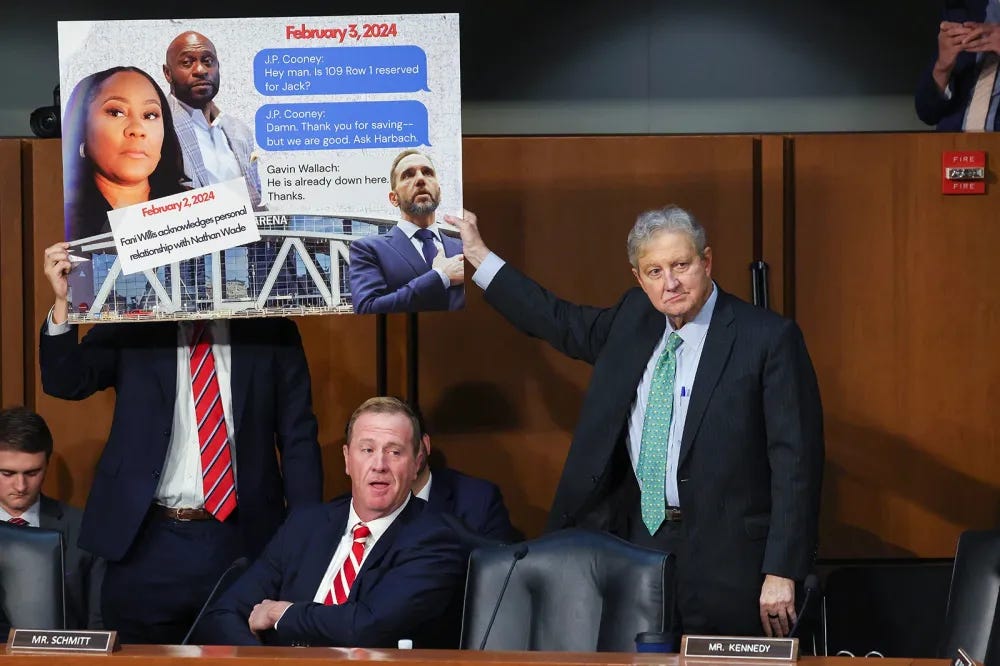
Schmitt claimed he had text messages showing Smith attended an Atlanta Hawks game in Atlanta on February 3, 2024. From there, he appeared to build toward something much larger: the implication that Smith might have been in Georgia around the time Fulton County District Attorney Fani Willis and prosecutor Nathan Wade were under intense scrutiny.
Then the “evidence” collapsed.
The basketball team in question was not the Atlanta Hawks.
It was the Iowa Hawkeyes.
The game was not in Atlanta.
It was at the University of Maryland in College Park.
And Jack Smith remembered attending it because Caitlin Clark and Iowa were playing Maryland that night. AP and Reuters independently confirmed the mix-up, while the official Senate Judiciary Committee page confirms Smith was testifying at the September 29 oversight hearing. AP News
That would be embarrassing enough.
But before getting those basic facts straight, a United States senator had already told a sworn witness, “I think you’ve already perjured yourself,” and later called him a “total dirtbag.” CBS News documented the exchange and Amy Klobuchar’s subsequent demand that Smith be allowed to see the supposed evidence. CBS News
This is not ultimately a story about basketball.
It is a story about what happens when accusation outruns verification.
What Happened
Schmitt began by asking Smith whether he had attended a February 3, 2024 NBA game between the Golden State Warriors and Atlanta Hawks.
Smith said no.
Schmitt pressed harder.
He suggested he possessed messages from Smith’s team showing otherwise and gave Smith a moment, as he put it, so Smith would not “perjure” himself.
Smith remained puzzled because the premise was wrong.
The texts apparently referred to a basketball game involving Iowa. Smith recalled attending Maryland-Iowa to see Caitlin Clark. Sen. Amy Klobuchar then supplied the rather devastatingly simple missing fact:
Iowa’s teams are called the Hawkeyes.
AP reported that Schmitt appeared to have confused teams playing roughly 650 miles apart. Reuters likewise reported that Iowa and Maryland played in Maryland on February 3, 2024. AP News
That distinction destroyed the geographic premise behind Schmitt’s questioning.
Smith was not admitting to being at an Atlanta Hawks game.
He was describing an Iowa Hawkeyes game in Maryland.
Maryland is not Georgia.
Hawkeyes are not Hawks.
And similarity between two team names is not evidence of prosecutorial coordination.
The Pattern
What makes this episode consequential is not simply that Schmitt made a mistake.
Politicians make mistakes. Witnesses make mistakes. Reporters make mistakes. Professors make mistakes.
The question is what someone does before turning uncertain information into an accusation of criminal conduct.
Perjury is not a synonym for “I think your answer is wrong.”
It is a serious allegation that a witness knowingly lied under oath about a material fact.
Yet the sequence here ran backward: accusation first, verification later.
Even more striking, Schmitt had a visual display of the messages available during the hearing. Smith asked to examine it, and Democratic senators pressed for it to be shown again. Once the underlying reference was scrutinized, the supposed Atlanta connection disintegrated. CBS, AP and The Washington Post all reported the same central sequence. CBS News
That should bother people regardless of how they feel about Jack Smith.
Because congressional oversight is most valuable precisely when lawmakers do have serious questions to ask.
And there were serious questions available.
Why This Matters
Republicans entered the hearing with substantive concerns about Smith’s investigations.
Chairman Chuck Grassley and other Republican senators questioned Smith about investigators obtaining telephone records connected to lawmakers, information concerning political donors, and communications involving journalists and government officials. Reuters reported that Smith defended those investigative steps and said records involving senators were relevant because investigators had evidence Trump and his allies were trying to contact lawmakers while certification of the 2020 election was being disrupted on January 6. Republicans dispute his justification and argue the investigation exceeded proper boundaries. Reuters
Those are legitimate subjects for congressional examination.
They involve prosecutorial authority, separation of powers, privacy, investigative procedure and political neutrality at the Justice Department.
That is exactly why the Schmitt episode matters.
When lawmakers possess real oversight questions but replace careful examination with theatrical certainty, they weaken their own case.
You do not strengthen an allegation of government misconduct by making another allegation that collapses under elementary fact-checking.
You make everything harder to trust.
And trust is already in desperately short supply.
The Timing Was Almost Too Perfect
There was another layer to Tuesday’s story.
Hours before the hearing, Axios reported that Schmitt had grown close to Vice President JD Vance and was being discussed as a possible future running mate should Vance seek the presidency in 2028. Axios reported that Vance viewed Schmitt as “trustworthy, intelligent, articulate and a deft political operator.” Axios
Then came the hearing.
I am not going to pretend one disastrous exchange tells us who will or will not appear on a presidential ticket two years from now.
It does, however, provide an extraordinary contrast.
On the same day Washington was discussing Schmitt as an important national political figure, millions of Americans were watching him confidently build a perjury accusation on a confusion between the Atlanta Hawks and Iowa Hawkeyes.
That contrast explains why the episode ricocheted far beyond the hearing room.
The criticism was not limited to progressive media. The conservative National Review also published sharply critical commentary about Schmitt’s performance. National Review
This was not simply one partisan camp laughing at the other.
The underlying factual error was independently verifiable.
The Bigger Hearing
It is also important not to reduce the entire Jack Smith hearing to one viral exchange.
Smith was questioned for hours over his investigations of Donald Trump.
Republicans accused him of weaponizing federal law enforcement and improperly targeting Trump, conservative organizations, lawmakers and others. Democrats argued that Smith had followed established Justice Department processes and that the attacks on him were politically motivated. Smith said his charging decisions were based on evidence rather than Trump’s political affiliation. Reuters
These disputes deserve scrutiny.
Smith is not above scrutiny because he investigated Donald Trump.
Neither are senators above scrutiny because they are scrutinizing Jack Smith.
That is how a functioning constitutional system is supposed to work.
Power questions power.
Evidence tests evidence.
Nobody gets an exemption because we like whose side they are on.
And that principle has to apply equally.
The Most Dangerous Word in the Hearing Was Not “Hawkeyes”
It was perjury.
Think about the escalation.
A senator possessed an ambiguous reference to basketball.
He interpreted it as an Atlanta Hawks game.
From that he inferred Atlanta.
From Atlanta he suggested possible contact with Georgia prosecutors.
And before establishing the first factual link in that chain, he publicly accused the witness of lying under oath.
That is how misinformation acquires authority.
Not necessarily because someone fabricates a document.
Sometimes it happens because someone sees what he expects to see, builds an interpretation around it, and speaks with more certainty than the evidence warrants.
When ordinary people do that online, it creates misinformation.
When elected officials do it from a Senate dais, it arrives wrapped in institutional authority.
That makes the obligation to verify greater, not smaller.
How We Fight Back
Not by deciding that one political party has a monopoly on truth.
Not by pretending Jack Smith is beyond criticism.
And not by answering one partisan performance with another.
The standard should be simpler.
Show the evidence. Read the evidence. Verify the evidence. Then make the accusation.
If a congressional witness lies, establish it.
If a prosecutor abuses government power, investigate it.
If a senator makes a serious factual allegation, examine the underlying material before accepting it.
Watch complete exchanges rather than ten-second clips. Read documents when they are available. Separate what witnesses actually said from what commentators claim they said. And demand the same evidentiary discipline from officials whose politics we share as from officials whose politics we oppose.
That is not left versus right.
That is citizenship.
The Line We Draw
Eric Schmitt’s mistake will become a meme because, admittedly, confusing the Atlanta Hawks with the Iowa Hawkeyes while attempting a dramatic congressional takedown almost writes the jokes itself.
But concentrating only on the comedy lets Washington off too easily.
The deeper problem is the willingness to convert uncertainty into certainty, suspicion into allegation, and allegation into condemnation before doing the most basic verification.
A Senate hearing is not supposed to be a cable-news audition.
It is not supposed to be a viral-content factory.
It is one of the places where the immense investigatory powers of the United States Congress are exercised in public.
That should demand something more than performance.
It should demand preparation.
It should demand restraint when the evidence is incomplete.
And when someone intends to accuse another American of committing a crime under oath, it should certainly demand knowing whether the basketball team in the evidence is located in Atlanta or Iowa.
That is not an unreasonable standard.
It is about the lowest one a democracy can afford.
If you think public officials should have their facts straight before accusing someone of a crime, Restack this one.
P.S. Release the Epstein Files.
What a pathetic bunch of clowns the republican party has become! Get rid of every last one of them in November 2026!