

By Dr. John Petrone
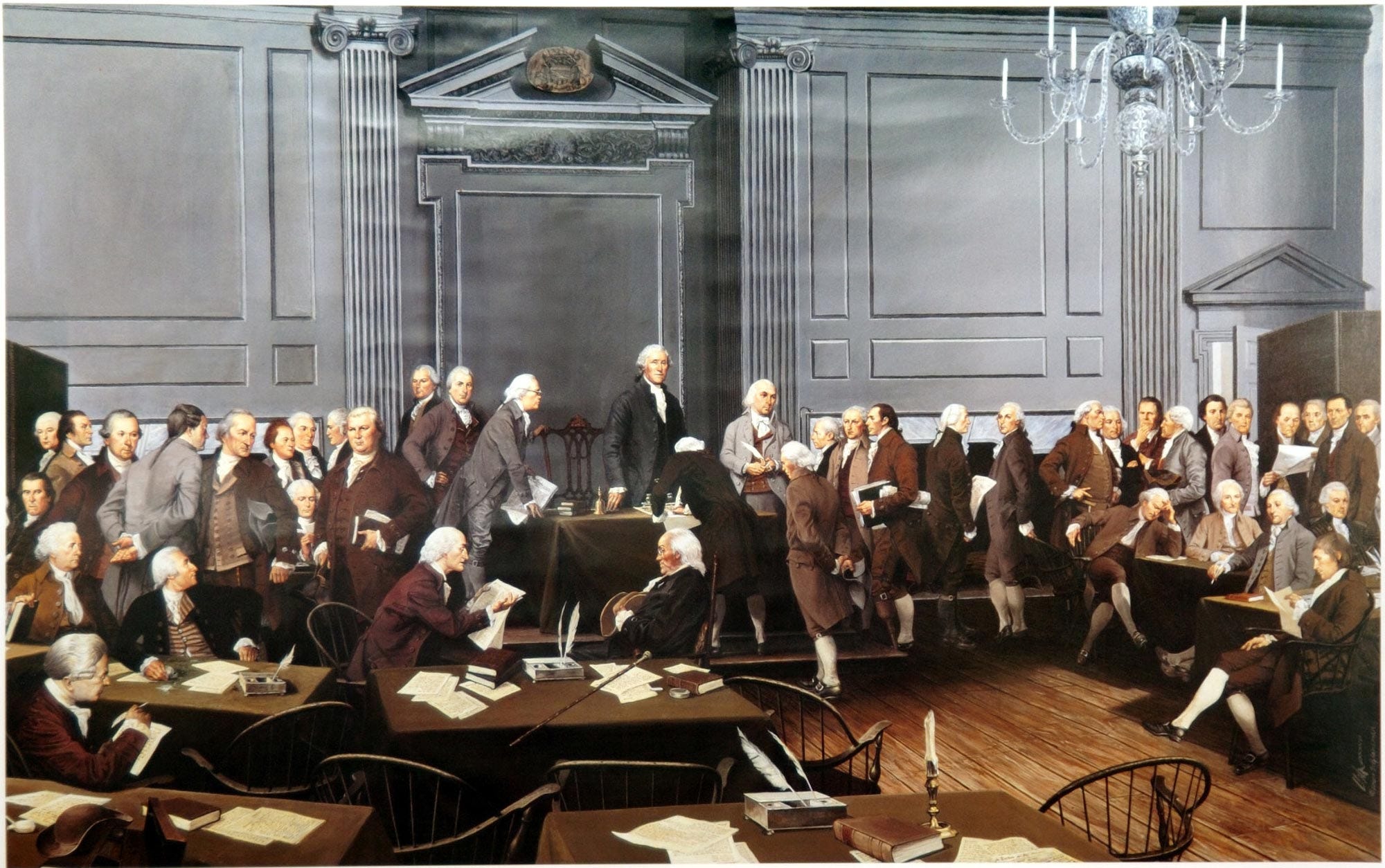
Two hundred thirty-nine years ago today, delegates in Philadelphia signed the United States Constitution.
On September 17, 1787, 39 delegates placed their names on a document designed around a central insight: political power must have limits. The Framers created three branches of government, divided authority between the federal government and the states, and deliberately made it difficult for any one person or institution to exercise unchecked power.
That makes Constitution Day more than a historical commemoration.
It is an appropriate day to ask a harder question:
How well are those constitutional limits holding in 2026?
The answer is complicated. There are serious constitutional disputes unfolding right now involving elections, due process, executive authority, free speech, and judicial independence. But there is another part of the story that deserves equal attention: courts are still issuing orders, states are still challenging federal action, Congress still possesses enormous constitutional authority, and citizens still have the right to challenge their government.
The Constitution is being tested.
It is also still working.
Who Controls Our Elections?
One of the clearest constitutional disputes heading into the November midterms concerns who has authority to make election rules.
Article I, Section 4 gives state legislatures primary responsibility for the “Times, Places and Manner” of congressional elections while allowing Congress to alter those rules by law. The Constitution does not assign that legislative authority to the president.
That distinction has suddenly become very important.
The Trump administration attempted to impose new requirements on mail voting through the Postal Service, including changes involving voter information and barcoded ballot envelopes. Federal judges blocked the plan, questioning whether the executive branch and Postal Service possessed statutory authority to impose those election rules. On September 14, the Supreme Court left the restrictions blocked for the 2026 midterms. The administration argued that its measures were intended to strengthen election integrity; opponents argued that the executive branch was attempting to exercise powers belonging to states and Congress.
At the same time, FBI Director Kash Patel told senators this week that he would not categorically rule out FBI agents being present at polling places. Patel said the bureau would coordinate election-related work through its field offices. Democrats expressed concern that federal law enforcement could intimidate voters or interfere with locally administered elections.
Federal law enforcement unquestionably has legitimate responsibilities involving threats, violence, civil-rights violations, and election crimes. But the constitutional question is where legitimate law enforcement ends and federal interference with election administration begins.
That boundary deserves close attention.
Due Process Is Still Due Process
The Fifth Amendment does not say that only citizens may not be deprived of liberty without due process.
It says “no person.”
The Supreme Court has long recognized that people who have entered the United States generally receive protection under the Due Process Clause regardless of whether their presence is lawful, unlawful, temporary, or permanent.
That principle is now at the center of several immigration cases.
This month, the Fourth Circuit rejected the administration’s policy of mandatory immigration detention without bond hearings. According to the Associated Press, it became the ninth federal appeals court to reject that interpretation, while two other appellate courts have upheld it, creating a significant legal split that could ultimately require Supreme Court resolution.
And today, September 17, a federal judge’s order restricting warrantless immigration arrests in Southern California was unsealed. The ruling requires immigration officers to determine that a person is likely to escape before making certain warrantless arrests and requires documentation supporting probable cause. The government has pursued much more aggressive immigration enforcement and maintains broad federal authority to enforce immigration law. The courts are now determining where that authority meets constitutional and statutory limits.
Immigration policy can be debated vigorously.
The constitutional principle is different.
Government power is still constrained by law, even when the government is pursuing a legitimate policy objective.
Can a President Eliminate What Congress Created?
Another constitutional confrontation involves something that sounds bureaucratic but goes directly to the separation of powers.
The Trump administration has attempted to dismantle several federal agencies created by Congress by dismissing most employees and effectively stopping their operations.
This week, judges on the First Circuit Court of Appeals questioned whether a president can accomplish indirectly what he cannot necessarily do directly: eliminate congressionally created agencies without Congress repealing the laws that established them. A lower court had already ruled that the administration’s actions violated separation-of-powers principles. The Justice Department disputes that characterization and argues that the challenged actions fall within executive authority to manage the federal government.
This is not fundamentally a debate about whether these particular agencies are useful.
Congress can abolish agencies.
Congress can reduce their budgets.
Congress can rewrite their missions.
The constitutional question is whether the executive branch can effectively erase institutions that Congress created while bypassing Congress itself.
That question goes to the architecture of the Constitution.
Congress.gov’s Constitution Annotated explains why the Framers divided legislative, executive, and judicial powers in the first place: concentrating those powers risked arbitrary government and threatened individual liberty.
Judicial Independence Is Not Optional
Americans have every right to criticize judges.
Presidents have that right too.
But criticism of a court decision is different from intimidation of judges, threats against their families, or refusal to comply with judicial orders.
Recent research described by the Associated Press found that federal judges have increasingly installed panic buttons, hired private security, altered their travel routines, and fortified their homes because of threats and harassment. One judge interviewed for the research acknowledged considering whether a ruling might expose the judge’s family to danger.
That should concern Americans regardless of which party appointed the judge or which side wins a particular case.
President Trump has also publicly attacked Supreme Court decisions that have gone against his administration, including this week’s ruling leaving the mail-ballot restrictions blocked. At the same time, the Court has ruled in the administration’s favor in numerous other cases. Judicial disagreement with a president is not evidence that the system has failed. It is precisely what an independent judiciary sometimes produces.
Article III establishes an independent federal judiciary, and judicial review has become one of the defining mechanisms by which government actions are tested against the Constitution.
A constitutional republic cannot function if judges begin deciding cases based on who might threaten them afterward.
The First Amendment Protects Uncomfortable Speech
Another current dispute goes directly to the First Amendment.
A federal judge this week blocked the Department of Homeland Security from threatening prosecution against a New York man over an email fiercely criticizing ICE leadership. The court concluded that the government could investigate genuine threats but could not use government authority simply to suppress protected political criticism. DHS has maintained that it investigates credible threats against law-enforcement personnel and denies attempting to silence lawful dissent.
That distinction is essential.
Threatening violence is not the same thing as criticizing government.
Political speech is often angry, offensive, unfair, or unpleasant. The First Amendment was not written merely to protect polite speech that government officials enjoy hearing.
There is also a broader, bipartisan dimension to this problem. Just yesterday, a Senate committee advanced legislation intended to prevent government officials from coercing private companies into suppressing protected speech. Supporters cited accusations involving actions by both the Trump and Biden administrations.
That is an important reminder.
Constitutional limits should not depend on which party controls the government.
The Pattern: Power Tests, Institutions Respond
Look across these disputes and a recognizable constitutional pattern emerges.
The executive branch claims authority.
States, citizens, organizations, or other officials challenge that authority.
Courts determine whether the government has exceeded constitutional or statutory limits.
Congress retains the power to legislate, investigate, appropriate money, create institutions, abolish institutions, and define the lawful boundaries of executive action.
That friction can look chaotic.
But much of that friction is intentional.
The Framers did not create an efficient government in which everyone answered to one person. They created competing centers of power precisely because they distrusted concentrated authority.
The danger is not disagreement among the branches.
The greater danger would be a system in which those disagreements no longer mattered.
There Is Another Side to This Story
It would be misleading to commemorate Constitution Day by suggesting that every constitutional guardrail has disappeared.
They have not.
Federal judges have blocked executive actions they concluded exceeded statutory or constitutional authority.
The Supreme Court this summer rejected President Trump’s attempt to restrict birthright citizenship, holding that the Fourteenth Amendment protects the longstanding principle that nearly everyone born in the United States is a citizen.
This week, the Court declined to permit sweeping new mail-ballot restrictions immediately before the midterms.
Federal courts continue reviewing immigration enforcement.
States continue suing the federal government.
Congress continues exercising legislative and oversight authority.
Journalists continue investigating government.
Citizens continue criticizing their leaders.
Those are not minor details.
They are evidence that the constitutional system still possesses functioning checks.
What Constitution Day Should Remind Us
The Constitution does not belong to a president.
It does not belong to Congress.
It does not belong to the Supreme Court.
It does not belong to Democrats or Republicans.
It begins with three words that answer the question of ownership:
We the People.
That does not mean every political disagreement is a constitutional crisis. Presidents possess enormous lawful authority. Congress possesses enormous lawful authority. States retain enormous authority. Courts sometimes disagree with one another about where those powers begin and end.
That is why precision matters.
We should distinguish policies we dislike from actions that actually exceed constitutional authority. We should distinguish political rhetoric from unlawful government retaliation. We should distinguish legitimate law enforcement from violations of due process. And we should distinguish criticism of judges from intimidation intended to alter judicial decisions.
239 Years Later
When the Constitution was signed on September 17, 1787, it was not perfect.
It tolerated slavery.
It did not guarantee women the vote.
It contained no Bill of Rights.
Those failures would require amendments, war, protest, litigation, legislation, and generations of Americans demanding that the country’s institutions live more fully by its stated principles.
The genius of the Constitution was never that the document solved every problem.
It was that it created a system capable of correcting itself while restraining power.
That system is under considerable pressure in 2026.
The question on this Constitution Day is therefore not whether Americans agree about Donald Trump, immigration, mail voting, federal agencies, or any particular court ruling.
The more fundamental question is whether we still agree on something older than any of those controversies:
No president is above the Constitution.
No Congress is above the Constitution.
No judge is above the Constitution.
And no political cause becomes constitutional simply because our side believes deeply in it.
Two hundred thirty-nine years after those signatures were placed on parchment in Philadelphia, that principle remains the foundation of the American experiment.
The Constitution survives not because it sits protected behind glass at the National Archives.
It survives because Americans continue insisting that power has limits.
We the People.
Still the most important words in American government.