

By Dr. John Petrone
This Substack is reader-supported. To receive new posts and support my work, consider becoming a free or paid subscriber.
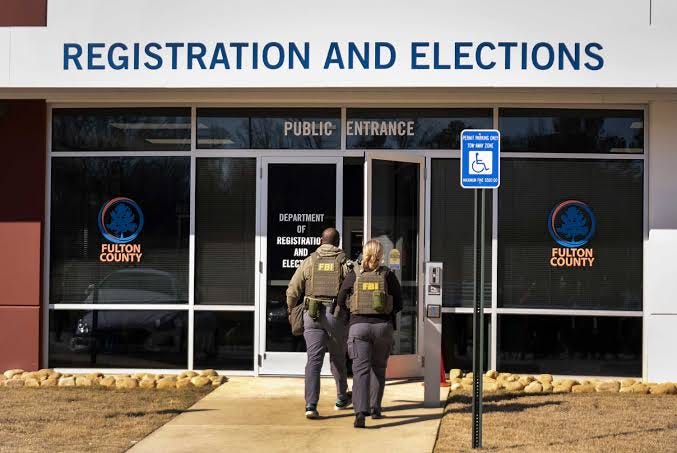
There is an important difference between protecting an election and exercising federal power at the place where Americans cast their ballots.
That distinction moved to the center of the 2026 midterm election Tuesday when FBI Director Kash Patel appeared before the Senate Judiciary Committee.
Pressed by Sen. Peter Welch of Vermont about whether FBI agents would be sent to polling locations in November, Patel did not give the categorical assurance Welch was seeking.
Instead, Patel pointed to election coordinators stationed throughout the FBI’s field-office network and said election integrity was a priority for the bureau. The Washington Post reported that Patel “would not say whether FBI agents would be deployed to polling locations” during the midterms.
That exchange would have been significant by itself.
It was not the only election story breaking Tuesday.
What Happened
Patel told senators that the FBI has election coordinators operating from its 56 field offices. That part is not new.
The FBI does, in fact, have 56 field offices, and Election Crime Coordinators have existed for previous elections. Justice Department guidance from earlier election cycles describes specially trained FBI agents serving in those roles and receiving election-crime complaints while polls are open.
That distinction matters.
Having an FBI agent designated to investigate threats, fraud, foreign interference, or other potential federal crimes is very different from stationing armed agents at a voting location.
The FBI itself describes its election role as “important but limited.”
The unanswered question Tuesday was therefore not whether the FBI investigates election crimes.
It does.
The question was whether federal law-enforcement agents might actually be deployed to polling places during the November election.
Patel did not provide a clear yes-or-no answer.
The Pattern
That uncertainty comes against a much larger fight over federal involvement in the 2026 elections.
In February, President Trump said Republicans should “nationalize” voting and “take over” voting in at least 15 locations. The White House later said there were no “formal plans” to send ICE officers to polling sites, while declining at the time to categorically rule out a federal presence nearby.
The administration has also sought greater access to state voter rolls. By August, Reuters reported that the administration had lost 21 consecutive court battles in efforts to force states to provide voter data.
The Justice Department has separately warned election officials nationwide that they could face prosecution for knowingly allowing ineligible noncitizens to remain on voter rolls. The administration describes these efforts as election-integrity measures.
And there is another important piece of context.
Federal election monitoring itself is neither new nor automatically improper.
The Justice Department’s Civil Rights Division regularly sends personnel to polling locations to monitor compliance with federal voting-rights laws. This year the department says it has monitored hundreds of polling locations across 11 states during the primary season and intends to continue monitoring during the general election.
So the issue is not simply whether federal officials can ever be involved in an election.
They can.
The issue is what they are doing, under what legal authority, and whether that activity crosses from legitimate enforcement or civil-rights monitoring into intimidation or interference.
Then Came Another Story Tuesday
While Patel was testifying, Reuters published an extensive investigation based on interviews with more than 50 state and local election officials.
Those officials described preparations for circumstances that would have sounded extraordinary not long ago: federal agents appearing at election facilities, demands for voting records or equipment, emergency litigation, cyberattacks, misinformation and threats against election workers.
Some jurisdictions have added physical security, retained outside attorneys and developed plans for responding to federal demands.
Reuters reported that election officials are preparing for these possibilities even while acknowledging that some feared scenarios may never occur.
That is worth emphasizing.
Preparation is not proof that federal intervention will happen.
Patel’s testimony is not proof that FBI agents will appear at polling places.
But state and local election officials are planning for the possibility.
And that tells us something about the level of institutional distrust surrounding this election.
The Supreme Court Stepped In Too
Tuesday brought another major development.
The Supreme Court rejected the Trump administration’s attempt to impose new restrictions on mail voting shortly before the midterms.
The disputed rules would have required changes to ballot envelopes and the transmission of voter information through a federal system. Election officials argued that implementing those requirements so close to an election could prevent otherwise valid ballots from being counted.
The Court allowed existing state mail-voting procedures to continue while the underlying legal dispute proceeds.
The ruling followed decisions by two federal judges who had already blocked the administration’s proposed mail-ballot rules. One of those judges, Carl Nichols, was appointed by Trump.
That matters because this is not simply a dispute between Democrats and Republicans.
It is also a dispute about institutional authority—what presidents may order, what federal agencies may implement, what states control and what courts will permit.
What the Law Actually Says
There is also a federal statute that deserves considerably more attention.
18 U.S.C. § 592 makes it a crime for a person in federal civil or military service to bring or keep “troops or armed men” at a place where a general or special election is being held, except when necessary to repel armed enemies of the United States.
Violation can carry up to five years in prison and disqualification from holding federal office.
Separately, the chairman of the Joint Chiefs of Staff said last month that there were no plans to deploy military personnel or National Guard troops to polling sites during the midterms.
Again, federal election activity itself is not prohibited.
Federal prosecutors investigate election crimes.
The FBI investigates threats, corruption, foreign interference and violations of federal election law.
The Justice Department monitors compliance with voting-rights statutes.
Those functions have existed through Republican and Democratic administrations.
But an armed federal presence at polling locations raises a distinctly different set of legal questions.
The Line We Draw
That is why Patel’s exchange with Welch deserves attention without exaggerating what actually happened.
Patel did not announce Tuesday that FBI agents would be stationed at polling places.
But he also did not give senators an unequivocal assurance that they would not be.
Instead, he emphasized the FBI’s election mission and its nationwide network of election coordinators.
Those coordinators are real.
Their existence is longstanding.
Their normal job is legitimate.
The unresolved issue is whether the bureau’s role in November will remain within those traditional boundaries.
And that question arrives at a moment when state election officials are preparing for possible federal intervention, courts are repeatedly being asked to define federal election authority, and the Supreme Court has just prevented a major change to mail voting from taking effect immediately before Americans vote.
That is the larger story.
Not one angry exchange in a Senate hearing.
Not one quote.
Not one lawsuit.
It is the accumulation of actions, court cases, contingency plans and unanswered questions surrounding an election that is now only weeks away.
The most useful thing Americans can do is pay close attention to the distinction between ordinary election-security work and actions that would alter who controls, administers or physically oversees the voting process.
That distinction may become one of the most important legal questions of the 2026 midterms.
If this source-backed analysis was useful, consider restacking it so others can follow the facts as this develops.