
By Dr. John Petrone
On the eve of early voting, I keep thinking about a lecture hall in Hangzhou, China, in the spring of 1999.
I had expected maybe 20 or 30 college students.
Instead, I walked into a large lecture hall filled with a couple hundred.
Then I looked toward the back.
Standing at the open windows were men whom I believed were Chinese security or intelligence personnel, watching what was happening and, from my perspective, recording it.
At that moment, the casual English-language discussion I thought I had agreed to suddenly felt considerably more serious.
I remember thinking:
John, understand where you are.
I did.
What happened over the next two hours became one of the most memorable experiences of my life—and one of the reasons I take words like Communism, Socialism, Fascism, propaganda, and democracy so seriously today.
After 25 years and counting as an educator, I have become increasingly concerned about something very basic:
We are losing the meaning of words.
And once words lose their meaning, they become remarkably easy to weaponize.
I DIDN’T LEARN ABOUT COMMUNISM FROM A MEME
In the spring of 1999, I was finishing my undergraduate degree in Political Science and History at Long Island University.
I was also already a United States Air Force veteran, and an older non-traditional student.
That semester, I traveled to the People’s Republic of China to study abroad at Zhejiang University in Hangzhou.
I studied Chinese history, Mandarin, and the history of the Chinese Communist Party.
Today, Zhejiang University is one of the world’s leading universities. The 2026 Academic Ranking of World Universities places it among the top universities globally.
But rankings were not why I went.
I went for one reason:
Perspective.
I had studied China through American textbooks and in American classrooms.
I wanted to experience China in China.
I wanted to listen to Chinese professors.
I wanted to talk with Chinese students.
I wanted to hear how they understood their own history.
Then I wanted to compare what I heard with what I had learned in the United States.
Not because I expected to agree with everything.
Because I wanted to understand it.
There is a tremendous difference.
Education should not shelter us from ideas.
It should prepare us to examine them.
THE TWO PHOTOGRAPHS
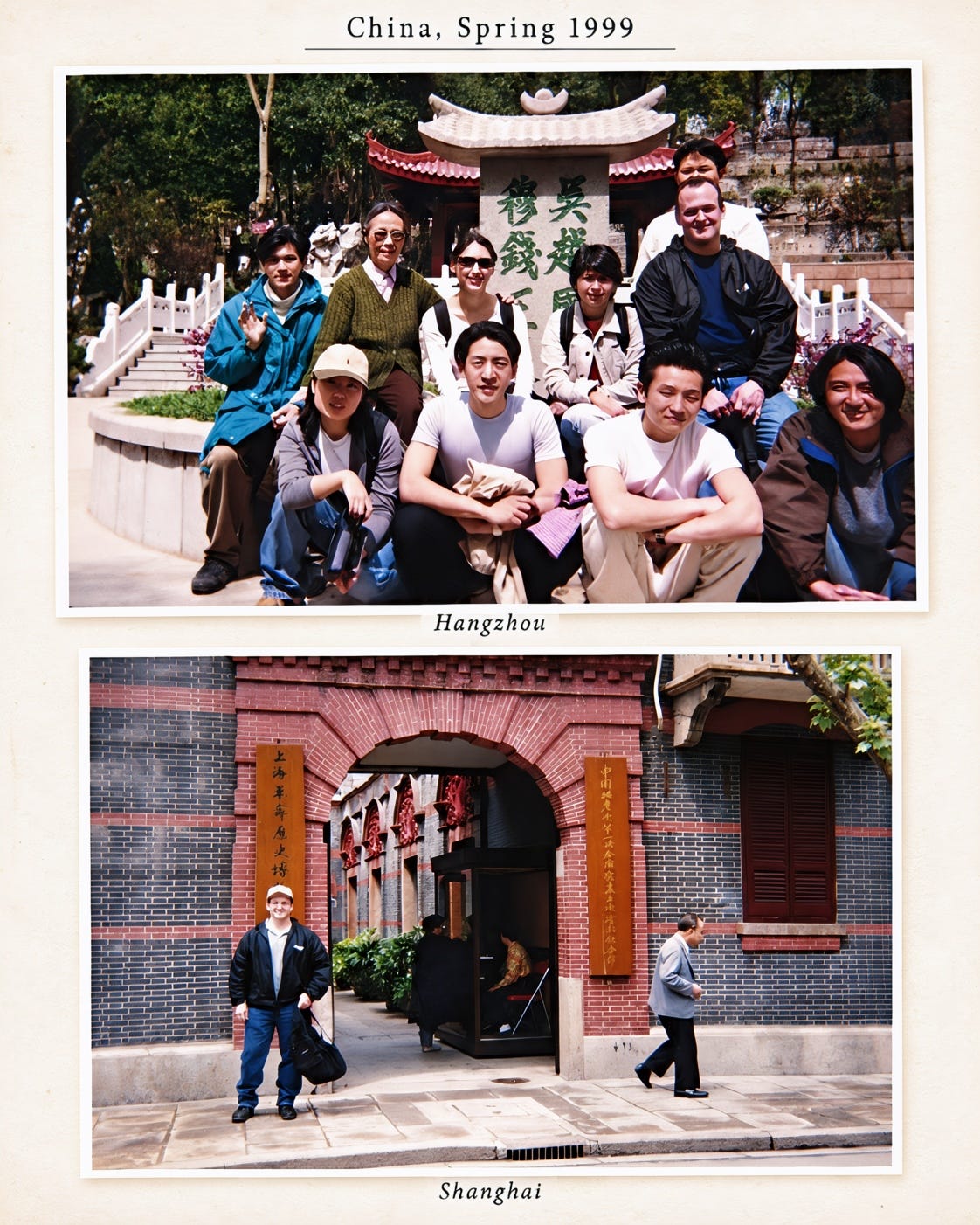
The two photographs accompanying this article were taken during that semester.
[PHOTO 1: My Mandarin class on a field trip in Hangzhou, Spring 1999]
The first is me with members of my Mandarin class during a field trip in Hangzhou.
I love that photograph because it captures what so much of the semester actually looked like:
Students.
Professors.
Conversations.
Field trips.
Learning.
People from very different backgrounds getting to know one another.
It is easy to reduce another country to its government.
It becomes much harder once you have eaten with its people, laughed with them, studied beside them, and called some of them friends.
[PHOTO 2: Shanghai, outside the site of the First National Congress of the Chinese Communist Party, Spring 1999]
The second photograph is of me in Shanghai during a day trip led by my Chinese history professor.
I am standing outside the historic site where the First National Congress of the Chinese Communist Party convened in July 1921, an event associated with the founding of the Party.
Consider the scene.
An American.
A United States Air Force veteran.
A Political Science and History student.
Standing at one of the foundational sites of Chinese Communism.
I was not there to embrace Communism.
I was not there to protest Communism.
I was there to study it.
That is what education is supposed to do.
WORDS ACTUALLY MEAN SOMETHING
Today we routinely hear political opponents described as:
Communists.
Socialists.
Marxists.
Fascists.
Sometimes the same person somehow becomes all four.
That should immediately raise a question.
Because these terms are not synonyms.
Communism, in classical theory, ultimately seeks the replacement of capitalist ownership of the major means of production with common ownership and the elimination of economic class divisions. Historically, governments ruled by Communist parties frequently became one-party states exercising extensive political and economic control.
That means Social Security is not Communism.
Medicare is not Communism.
Public education is not Communism.
Veterans’ benefits are not Communism.
Building highways is not Communism.
Regulating corporations is not Communism.
Government doing something does not automatically make that thing Communist.
Socialism is a broader family of economic and political ideas involving substantially greater social, public, cooperative, or worker ownership or control of economic resources.
Then there is social democracy.
Social democracy can coexist with:
Private property.
Private businesses.
Entrepreneurship.
Investment.
Markets.
Capitalism.
It combines those things with public programs, regulation, worker protections, pensions, health programs, and a social safety net.
Those distinctions matter.
Then there is Fascism.
Historically, Fascism has been authoritarian and ultranationalist, hostile to democratic pluralism and political opposition, and associated with concentrated political power, propaganda, scapegoating, and suppression of dissent.
And this is where casually throwing all these terms together collapses historically:
Fascists and Communists were enemies.
After the Nazis came to power in Germany, Communists and Social Democrats were among the political opponents they targeted. The U.S. Holocaust Memorial Museum notes that the first prisoners at Dachau included Communists and that Nazi authorities subsequently intensified their repression of Communists, Social Democrats, trade unionists, and other opponents.
So when someone describes the same political opponent as a Communist, Socialist, Marxist, and Fascist, there is a perfectly reasonable response:
Define the words.
Political vocabulary should help us understand reality.
It should not simply frighten us.
AND THEN THERE IS DEMOCRACY
We misuse this word too.
Democracy does not mean:
“My side wins.”
A functioning democracy involves representation, political rights, participation, and the rule of law—including credible elections, civil liberties, lawful limits on government power, and meaningful opportunities for citizens to participate politically.
That means democracy requires something difficult of us:
We have to accept that people with whom we strongly disagree are still entitled to participate.
We can criticize their ideas.
We can oppose their policies.
We can vote against them.
But disagreement itself is not evidence that someone is a Communist, a Fascist, or anything else.
Labels require definitions.
Claims require evidence.
TWO DIFFERENT VERSIONS OF THE WORLD
Living in China in 1999 gave me an unusual education in information.
I watched Chinese state television.
I listened to Chinese professors.
I talked with Chinese students.
But at night, I also had a shortwave radio.
Through it, I listened to the BBC and Voice of America.
Sometimes I felt as though I were hearing descriptions of two completely different worlds.
This was particularly true as conflict intensified in the Balkans.
I would hear one account from Chinese media.
Then I would hear another from the BBC or VOA.
That did not mean every Western report was automatically correct or every Chinese report automatically false.
It meant something much more important:
I had competing narratives to compare.
I had to listen.
Question.
Compare.
Think.
And then decide what I believed the evidence supported.
I did not realize at the time how valuable that habit would become.
THEN I WALKED INTO THAT LECTURE HALL
Near the end of one of my Mandarin classes, two students entered the room and spoke with my professor.
She called me to the front.
She introduced them as the president and vice president of Zhejiang University’s English Language Club.
Their club held weekly gatherings where students could practice English with invited English-speaking guests.
They asked whether I would participate.
The format sounded simple:
One hour discussing current events.
One hour discussing everyday life in America.
Sure.
Why not?
I pictured 20 or 30 students sitting around a classroom.
When the day arrived, the president and vice president met me at Zhejiang’s main gate.
I was living off campus in the foreign-student residence.
We walked for quite a while.
Then we entered a large lecture hall.
And I saw the audience.
A couple hundred students.
That was not what I had expected.
Then I noticed the men standing at the open windows in the back.
From everything I could observe, I believed they were Chinese security or intelligence personnel.
And from my perspective, they appeared to be recording the proceedings.
My calculation changed immediately.
I told the club president:
“This is not what I expected.”
I remember wondering whether I had somehow been set up.
Before we began, I gave him two conditions:
No questions about Taiwan.
No questions about Tibet.
He agreed.
He walked to the large board at the front of the lecture hall and wrote down the ground rules.
There were audible groans from the audience.
I held my ground.
Those subjects were off limits.
Otherwise, I was leaving.
Remember the circumstances.
This was China in 1999.
I was an American military veteran and a nontraditional university student standing in front of a couple hundred Chinese university students.
At the open windows in the back of the lecture hall were men whom I believed were Chinese government security or intelligence personnel, watching what was happening and, from my perspective, recording it.
I was interested in cultural exchange.
I was not interested in becoming an international incident.
THE QUESTIONS GOT HEATED
The first hour began.
The topic was current events.
And the Balkans came up almost immediately.
The questioning became intense.
At times, it bordered on heated.
The themes reflected much of what I had been hearing from Chinese media:
American imperialism.
American interference in the affairs of other countries.
American military power.
America imposing its will on weaker nations.
I responded based on what I had been hearing through the BBC and VOA and from my own understanding of events.
They pushed back.
I pushed back.
A couple hundred Chinese students were listening.
The men at the open windows in the back were still watching and, as I understood it, recording.
Eventually, I realized something.
We were not going to resolve the Balkans in that lecture hall.
So I said, essentially:
“You hear what you hear from your government, and I hear what I hear from mine. Let’s agree to disagree.”
And then the first hour ended.
THEN SOMETHING WONDERFUL HAPPENED
The topic shifted from geopolitics to everyday life in America.
Almost instantly, the atmosphere changed.
What movies do Americans watch?
What cars do we drive?
What is American fast food really like?
What are American schools like?
What was it like serving in the United States Air Force?
Suddenly we were laughing.
Talking.
Enjoying one another.
The political tension disappeared.
For that hour, we were not representatives of competing governments.
We were human beings curious about one another.
At the end, the room erupted in applause.
And as I have joked ever since:
I didn’t get arrested. 😂
But that was not quite the end of the story.
THEN HISTORY FOLLOWED ME HOME
I returned to the United States.
And soon afterward, everything changed.
On May 7, 1999, NATO aircraft mistakenly bombed the Chinese Embassy in Belgrade. The United States subsequently apologized and described the strike as accidental.
China erupted in protest.
More than 30,000 university students reportedly marched in Hangzhou.
My friends in China began contacting me.
They told me that students from Zhejiang had marched toward the foreign-student residence demanding to see “the American” and wanting answers about what had happened.
“The American,” fortunately, had already returned to the United States and was staying at his sister’s home in California.
Talk about timing.
But something about that episode stayed with me.
These were the same kinds of students with whom I had laughed.
Studied.
Talked about movies.
Talked about cars.
Discussed America.
And suddenly a geopolitical event had transformed the atmosphere.
Nationalism.
Fear.
Anger.
Information.
Identity.
All collided.
PROPAGANDA DOES NOT REQUIRE STUPID PEOPLE
This may be the most important lesson I brought home from China:
Propaganda does not require stupid people.
The students I met were not stupid.
They were bright.
Curious.
Ambitious.
Educated.
Many were extraordinarily kind to me.
But like all human beings, they interpreted events partly through the information environment surrounding them.
And here is where Americans make a serious mistake if we are not careful:
We assume propaganda is something that happens to other people.
People living under dictatorships.
People in foreign countries.
People less educated than we are.
People on the “other side.”
That belief itself makes us vulnerable.
Because propaganda works best when we are convinced that we could never fall for propaganda.
Human beings have confirmation bias.
We notice information that reinforces what we already believe.
We are more likely to distrust information that threatens deeply held beliefs.
And when the same claim is repeated again and again, familiarity can begin to feel like truth.
That is why hearing something a thousand times does not make it evidence.
Repetition is not verification.
YOUR INFORMATION BUBBLE CAN BECOME A PRISON
In 1999, I had Chinese television on one side and my shortwave radio on the other.
Today, Americans have access to more information than I could have imagined sitting in my foreign-student residence in Hangzhou.
Yet technology has created a strange paradox.
We have access to nearly everything.
And many of us choose to hear only one thing.
One network.
One podcast.
One political personality.
One social-media ecosystem.
One set of Facebook friends.
One algorithm repeatedly feeding us content similar to whatever made us angry yesterday.
Eventually, a person can inhabit an information universe in which everybody they trust says essentially the same thing.
Then comes the dangerous step:
Anyone who disagrees must be lying.
The journalists are corrupt.
The professors are corrupt.
The scientists are corrupt.
The judges are corrupt.
The election officials are corrupt.
The historians are corrupt.
Every institution producing inconvenient evidence is corrupt.
Only the people telling us what we already believe can be trusted.
At that point, ask yourself:
What evidence could possibly change my mind?
If the answer is nothing, we are no longer practicing critical thinking.
We are protecting a belief.
There is a difference.
EDUCATION IS NOT ABOUT WHAT TO THINK
For 25 years and counting, education has been my life’s work.
I have been a teacher.
A school administrator.
And now a professor preparing future educational leaders.
I have never believed the purpose of education is to tell people what conclusions they must reach.
Quite the opposite.
Education should teach us how to reach conclusions responsibly.
Ask questions.
Find evidence.
Check sources.
Seek primary documents.
Compare competing explanations.
Understand context.
Recognize your own biases.
And—perhaps hardest of all—
Seriously consider the possibility that you might be wrong.
That is intellectual humility.
It is also intellectual strength.
DEFINE IT. DOCUMENT IT. DEMONSTRATE IT.
So when someone tells you a political opponent is a Communist:
Define Communism.
Then show the evidence.
When someone tells you a policy is Socialist:
Define Socialism.
Explain specifically why the policy fits.
When someone calls somebody a Fascist:
Define Fascism.
Identify the characteristics.
Show the evidence.
When someone claims an election was stolen:
Show verifiable evidence.
When someone makes an extraordinary political claim:
Ask for extraordinary evidence.
Do not give me a meme.
Do not give me a slogan.
Do not tell me some television personality said it.
Do not tell me that “everybody knows.”
Define it.
Document it.
Demonstrate it.
That standard should apply no matter who makes the claim—and no matter how desperately we may want the claim to be true.
HOW WE FIGHT BACK
The answer to propaganda is not censorship.
It is not replacing one information bubble with another.
And it certainly is not teaching people what they are permitted to think.
The answer is better thinking.
Read something written by someone with whom you disagree.
When a headline makes you furious, read the actual article.
When an article quotes a study, find the study.
When somebody describes legislation, read the legislation—or at least a credible, nonpartisan summary.
When someone quotes a political figure, find the full remarks and see what came before and after.
Distinguish news reporting from opinion.
Distinguish evidence from assertion.
Distinguish “I believe” from “I can demonstrate.”
Question your favorite news source at least as seriously as you question the one you cannot stand.
And occasionally ask yourself the most revealing question of all:
If the other side had done exactly the same thing, would I judge it the same way?
That question can be uncomfortable.
Good.
Education is supposed to make us uncomfortable occasionally.
That is how our thinking grows.
THE BOTTOM LINE
More than a quarter-century has passed since those photographs were taken.
I look at the young man standing in Shanghai outside the historic site associated with the founding of the Chinese Communist Party, and I recognize him.
But I also realize how much he still had to learn.
China taught me many things.
It taught me about history.
Culture.
Politics.
Nationalism.
Communism.
America.
And myself.
But perhaps the most lasting lesson was this:
Perspective is priceless.
I traveled halfway around the world because I wanted to understand another political system instead of simply accepting what someone else told me about it.
I did not come home Communist.
I did not come home less American.
I did not come home less proud of having served in the United States Air Force.
I came home better able to understand that the world is complicated—and that governments, media systems, political movements, and human beings all tell stories about reality.
In fact, the day my sister picked me up at LAX, when we reached her house, I got out of the car and kissed the ground in her front yard.
I was grateful to be back in my beloved USA.
Our responsibility as citizens is to determine which stories survive contact with the evidence.
So as voting begins, I am not going to tell you how to vote.
That decision belongs to you.
But after 25 years in education, I will ask something of you:
Think before you vote.
Read.
Question.
Compare.
Verify.
Challenge even the things you desperately want to believe.
And before asking:
“Does this agree with my side?”
Ask the question that matters far more:
“Is it true?”
A free society does not require us to agree.
It requires us to think.
And then it requires us to participate.
We the People United!
If this essay made you think, please subscribe, share it with someone who might appreciate the conversation, and invite them to join us here.
I am building this community around a simple idea:
We can disagree strongly about politics and still insist on history, evidence, education, critical thinking, and respect for the democratic process.
If that sounds like a conversation worth having, subscribe and come back for the next one.
I did something similar, John. I traveled to Cuba in 1987 when Fidel was in power, the Soviets were still stationed there, and it was illegal to do so. We flew from Montreal into Havana and when I arrived at customs they asked me if I wanted my passport stamped or not, giving me the option to avoid trouble entering back into the USA. I took the stamp. I went to learn about that island nation 90-miles from ours, first hand, free from American propaganda. It was the best learning experience of my life and I’ve always held a special place in my heart for Cuba, the Cuban people, and socialism. Viva!
Thank you for sharing this timely message.
My goodness I enjoyed this read.
What a wonderful and learning experience you had and now
giving back to us.
“Define, document, demonstrate, distinguish, question”.
A fine way to start each day.