
“NOT NEARLY LONG ENOUGH”: TRUMP JUST TOLD EXHAUSTED SAILORS EXACTLY WHAT HE THINKS
Families raised alarms. Trump denied them—and said a record deployment was “not nearly long enough.”
By Dr. John Petrone
A little more than a week ago, I wrote about the sailors and Marines aboard the USS Abraham Lincoln under the title:
THEY PRAISE THEIR “GRIT” WHILE LEAVING THEM TO ROT AT SEA.
At the time, military families were describing food shortages, broken toilets, moldy showers, shortages of basic hygiene supplies, exhausting work schedules and deep concern about the mental health of people who had been at sea for months.
The administration’s answer was largely denial.
Now Donald Trump has finally addressed it himself.
And somehow, he made it worse.
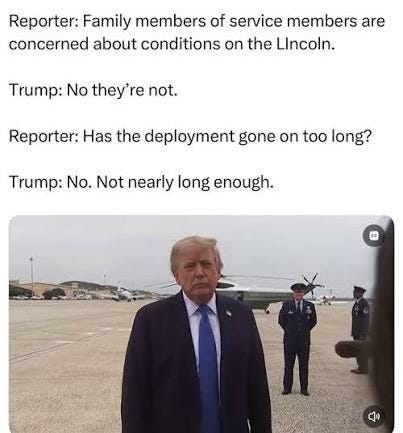
A reporter told the president that family members were concerned about conditions aboard the Lincoln.
Trump’s response?
“No, they’re not.”
Think about that.
Not: We’re looking into it.
Not: I have directed the Navy to make sure those sailors have everything they need.
Not: Their families deserve answers.
Not even: I disagree with some of the reporting.
He simply declared that the families weren’t concerned.
Then he was asked whether the deployment had gone on too long.
His answer was even more revealing:
“Not nearly long enough.”
The USS Abraham Lincoln has now been deployed for more than 260 days while supporting operations in the Middle East. The Pentagon is preparing to replace it with the USS George Washington.
More than 5,000 Americans have been serving aboard that ship.
They are not political props.
They are not scenery for presidential speeches.
They are sailors and Marines with spouses, parents, children and families waiting for them at home.
And their endurance is not an excuse to demand more endurance.
The Pattern
What happened Friday matters because it exposes a fundamental distinction that too many politicians refuse to understand:
Supporting the military is not the same thing as praising the military.
Anybody can stand in front of a flag.
Anybody can salute during a ceremony.
Anybody can call American troops warriors, heroes or patriots.
Leadership begins when those words become obligations.
Feed them.
Supply them.
Maintain their equipment.
Give them functioning sanitation.
Take mental-health concerns seriously.
Listen to their families.
And when extraordinary operational demands stretch people and equipment toward their limits, acknowledge reality instead of pretending that admitting a problem somehow demonstrates weakness.
The reporting is no longer coming from a single source. AP reports that the deployment has exceeded 260 days. NPR reports concerns about long hours, limited food and mounting stress. The Wall Street Journal reports congressional concern over food, personal supplies and plumbing problems. Task & Purpose reported that Navy leaders acknowledged toilet problems and difficulties moving food, supplies and mail to the ship during the conflict.
The Navy disputes some of the most serious characterizations. It says it has not seen an increase in suicidal ideation or suicide attempts aboard the ship, and the Pentagon has argued that reporting about conditions has exaggerated the situation.
Fine.
Investigate it.
Put responsible people aboard the ship.
Examine the food supply.
Inspect the sanitation systems.
Talk privately with sailors.
Review mental-health staffing and access.
Talk to families.
Determine what is true, what is exaggerated and what needs to be fixed.
That is what serious leadership looks like.
What you don’t do is tell military families that the concerns they are expressing do not exist.
Why This Matters
There is a dangerous mentality buried inside the phrase “not nearly long enough.”
It treats endurance as limitless.
Anyone who has served understands the difference between hardship that comes with military service and hardship caused by preventable neglect.
The military is difficult by design.
Deployments are difficult.
Combat operations are difficult.
Separation from family is difficult.
Long watches, unpredictable schedules, dangerous environments and personal sacrifice come with the uniform.
But none of that relieves civilian leadership of responsibility for the people asked to bear those burdens.
Quite the opposite.
The greater the sacrifice demanded from service members, the greater the obligation their government assumes toward them.
Sen. Ruben Gallego, a Marine veteran who deployed to Iraq, said today that he has heard reports of difficult working conditions, limited food and deteriorating morale, and is seeking greater congressional oversight. He wants lawmakers to visit the carrier themselves.
That’s precisely what should happen.
Not because every allegation has already been proven.
Because when credible allegations involve the health and welfare of thousands of American service members, you find out.
You don’t wave them away.
The Leadership Failure
Imagine being the spouse of a sailor who has been gone for most of a year.
Imagine receiving messages about exhaustion, sanitation problems, supply shortages or deteriorating morale.
Imagine watching every day as your husband, wife, son or daughter remains thousands of miles away aboard a ship involved in combat operations.
Then imagine hearing the commander in chief being told that families like yours are concerned.
And hearing him answer:
“No, they’re not.”
That is the part of this story that should infuriate Americans regardless of party.
Because the president cannot possibly know that those families aren’t concerned.
We know some are.
They have spoken publicly.
They have spoken to reporters.
They have spoken to lawmakers.
They have met with Navy officials.
Whether every complaint ultimately withstands investigation is a separate question.
Their concern is real.
Denying that reality accomplishes nothing except telling military families that their voices are inconvenient.
And following that dismissal with “not nearly long enough” sends an equally disturbing message to the people aboard that carrier:
However long you have been gone, however exhausted you may be, however much strain the deployment has placed upon you and your families—
Washington can always ask for more.
The Constitutional Stakes
The United States deliberately places the military under civilian control.
That is one of the foundational principles of our republic.
But civilian control carries responsibility.
Presidents and defense officials possess enormous authority over the lives of people who cannot simply decline an assignment because the conditions are unpleasant or because they would rather go home.
A sailor follows orders.
A Marine follows orders.
That is precisely why civilian leaders have a heightened obligation to use that authority responsibly.
The chain of command cannot become a chain of indifference.
Congress has a role here, too.
Oversight of military readiness is not anti-military.
Questioning living conditions is not undermining the troops.
Demanding adequate food, sanitation, supplies, medical support and reasonable operational planning is not weakness.
It is one of the ways a republic honors the people it sends into danger.
And there is another readiness issue that cannot be ignored.
Extended carrier deployments do not merely affect individual sailors. They affect equipment, maintenance cycles, training, families, retention and the Navy’s ability to meet the next crisis.
AP reports concern about the strain prolonged deployments are placing both on service members and their ships, while the deployment of the George Washington to relieve the Lincoln illustrates the larger force-management challenge involved.
There is nothing tough about exhausting your force unnecessarily.
There is nothing patriotic about pretending readiness has no human cost.
How We Fight Back
Congress should demand a complete accounting of conditions aboard the USS Abraham Lincoln.
Lawmakers should insist upon direct access to sailors without command pressure.
They should examine food and supply availability, sanitation, maintenance, operational tempo, sleep and work schedules, mental-health resources, mail and resupply problems, and the cumulative effect of this deployment on sailors and their families.
The Navy should release as much information as operational security and medical privacy permit.
And where legitimate problems exist, they should be corrected—not explained away.
This should not become another Washington exercise where one political party makes accusations, another automatically dismisses them, everyone retreats into ideological camps, and the people actually serving aboard the ship disappear from the discussion.
Put the sailors first.
Find the facts.
Fix the problems.
Bring accountability to the decisions that produced them.
And stop confusing silence with strength.
The Bottom Line
Donald Trump was handed one of the easiest opportunities imaginable for a commander in chief.
A reporter told him military families were worried.
All he had to do was acknowledge them.
He could have said:
I hear them.
We’re looking after their sailors.
We’re going to make sure conditions are right.
And we’re grateful for what these Americans and their families have sacrificed.
Instead, he denied their concern.
“No, they’re not.”
Then, when asked whether more than 260 days of deployment had been too long, he said:
“Not nearly long enough.”
Those words deserve to follow this administration every time it claims to champion America’s service members.
Because respect for the military is not measured by how loudly politicians praise troops when cameras are rolling.
It is measured by what they do when those troops are exhausted.
When their families are frightened.
When systems begin breaking down.
When somebody asks for help.
And when nobody in uniform is in a position to tell the commander in chief:
Enough.
The men and women aboard the USS Abraham Lincoln have done what their country asked them to do.
The question now is whether their country—and the leaders who command them—will do right by them.
We owe them more than applause.
We owe them leadership.
If you believe America’s service members deserve more than slogans, share this.
If you believe military families deserve to be heard rather than contradicted, share this.
And if you believe supporting the troops means holding the people who command them accountable, make sure Americans understand what happened today.
They served. They sacrificed. They endured.
The least their commander in chief can do is listen.
P.S. There is nothing partisan about demanding that Americans sent into harm’s way be properly supplied, cared for and heard. Presidents come and go. Our obligation to the men and women who serve this country does not.


Denial of the crime is an accessory to the crime.
Drumpf cares not a whit about those men and women. He was led by the nose by the Fascist prime minister and cabinet of Israel into this skirmish or excursion or don’t you dare call it a war to distract the world from their genocide in the Gaza Strip and the East Bank, where the fascist Israeli settlers keep stealing land