

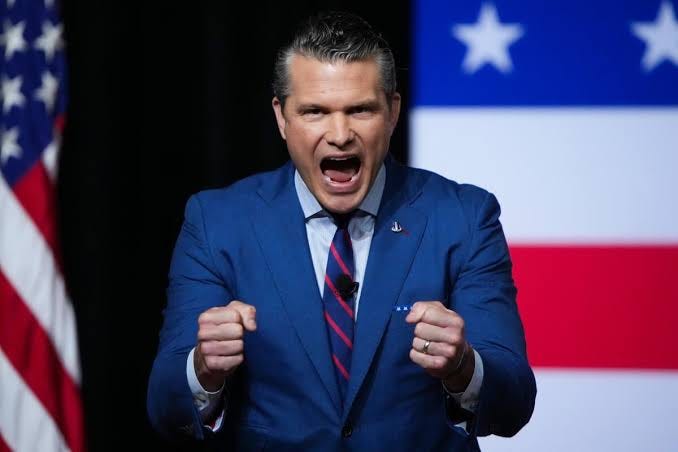
By Dr. John Petrone
This is no longer a story about Democrats attacking one of Donald Trump’s Cabinet secretaries.
It is a story about Republicans who helped put Pete Hegseth in charge of the Pentagon now publicly questioning whether he belongs there at all — while senior military leaders leave, crucial positions remain vacant, and the United States is engaged in an extended military conflict with Iran.
Sen. Thom Tillis of North Carolina has now crossed the line from criticism to an outright demand that Trump replace Hegseth.
And Tillis did not mince words.
After serving eight years on the Senate Armed Services Committee, he said he had “never witnessed more inept management” of America’s service members and accused Hegseth of being more interested in culture wars than the serious business of national defense.
That accusation would be significant coming from almost any Republican senator.
Coming from Thom Tillis, it is remarkable.
Because Pete Hegseth might not be Defense Secretary today without him.
Pete Hegseth at a Pentagon briefing in March 2026. U.S. Army photo.
[PAYWALL HERE]
What Happened
Army Secretary Dan Driscoll submitted his resignation this week after months of reported tensions with Hegseth.
Driscoll was hardly some anti-Trump holdover. He was selected by Trump, was a close friend and ally of Vice President JD Vance, and had become one of the administration’s most important advocates for transforming the Army around drones, inexpensive weapons, faster procurement, and the realities of modern warfare. Reuters reported that disagreements intensified as Hegseth removed senior Army leaders associated with those modernization efforts.
Then came something even more extraordinary.
The Washington Post reported that when Driscoll went to the White House to tell Trump he intended to resign, Trump encouraged him to stay, at least through the midterm elections. Driscoll also reportedly told the president about damage he believed Hegseth was doing to the Army.
The Pentagon disputes the characterization that the department is in disarray. Pentagon spokesman Sean Parnell called that premise “completely baseless” and argued that what critics are witnessing is reform.
That is the administration’s argument.
But the people raising alarms now include members of Trump’s own party.
This Is Bigger Than Thom Tillis
Tillis is simply the Republican saying the quiet part most loudly.
Sen. Mike Rounds of South Dakota, a senior Republican involved in defense issues, said he was disappointed by Driscoll’s departure and openly questioned the loss of respected generals.
“Where is the leadership at?” Rounds asked.
When reporters then asked whether he still had confidence in Hegseth, Rounds did not say yes. He replied that it was a matter of whether the president had confidence in him.
Rep. Don Bacon of Nebraska is even harder to dismiss.
Bacon is a Republican, a member of the House Armed Services Committee, and a retired Air Force brigadier general with nearly three decades of military service.
He has criticized the unexplained removal of senior generals and admirals and said Hegseth would not have been his choice for the job. Bacon told CNN that possessing the authority to remove officers does not automatically make doing so “right” or “wise.”
House Armed Services Committee Chairman Mike Rogers has reportedly had enough of the constant personnel turnover as well, saying:
“I’m tired of all the churn.”
That is not coming from Democrats.
That is the Republican chairman of the committee responsible for overseeing the Pentagon.
The Vote That Should Haunt Thom Tillis
There is an unavoidable irony here.
Pete Hegseth was confirmed on January 24, 2025, after the Senate split 50-50. Vice President JD Vance had to cast the tie-breaking vote.
Three Republican senators — Susan Collins, Lisa Murkowski and Mitch McConnell — voted against him. Tillis voted yes.
Had Tillis voted no, Hegseth’s nomination would have failed.
Think about that for a moment.
The Republican senator now telling America that he has never witnessed such inept management of our armed forces had the opportunity to prevent that man from becoming Defense Secretary.
He did not take it.
Whatever political pressure Tillis faced at the time, history records votes, not excuses.
But there is still something important about a senator publicly admitting, through his actions if not those precise words, that the decision went badly wrong.
The Driscoll Resignation Is the Real Story
The temptation is to turn all of this into another Washington personalities story: Hegseth versus Driscoll, Hegseth versus Tillis, Trump versus another Republican senator.
That misses the danger.
The issue is institutional capacity.
The Atlantic reported that Driscoll went directly to Trump with concerns about how many generals and senior officers had been fired, forced out or passed over for advancement. His argument was straightforward: the Army cannot modernize effectively if the people responsible for carrying out that modernization keep disappearing.
AP reported this week that Driscoll’s departure leaves the Army without its Senate-confirmed civilian secretary while other major leadership positions have also been disrupted. Republican senators are preparing to ask questions about precisely that problem when Congress returns.
And this is occurring while American forces are once again exchanging fire with Iran.
The military does not get to shut down for political restructuring.
Soldiers are still deployed. Ships are still at sea. Aircraft are still flying combat missions. Commanders still need decisions, logistical support, strategic direction and competent civilian leadership.
The Pentagon is not a cable-news green room.
Mistakes there have consequences measured in lives.
The Pattern
Hegseth’s problems did not begin with Dan Driscoll.
The Pentagon inspector general concluded last year that Hegseth’s use of Signal to transmit sensitive information about military operations created a risk to operational security that could have endangered American pilots and jeopardized mission objectives.
That was not a partisan accusation. It was the conclusion of the Defense Department’s own independent watchdog.
Then came the extraordinary turnover among senior military officers.
Then increasingly aggressive intervention in military promotions.
Then repeated battles over whether ideological conformity was beginning to substitute for professional military judgment.
Now one of Trump’s own Army secretaries has walked away after reportedly taking his concerns directly to the president.
And today, The Hill reports that Hegseth is headed toward a confrontation with Republican senators over senior-leadership turnover, strategy in the Iran conflict, military resources, and the administration’s request for more than $70 billion in additional national-security spending.
At some point, isolated controversies become a pattern.
We have reached that point.
The Pentagon’s Defense
There is another side to this, and it deserves to be stated accurately.
Trump continues to support Hegseth. The president praised him as recently as this week and said he believes Hegseth is doing a “fantastic job.”
Hegseth and his supporters argue that entrenched Pentagon bureaucracy needed disruption, that a president and defense secretary have every right to choose the military leadership they believe best suited to carry out their policies, and that many complaints about Hegseth reflect resistance to fundamental change.
Republican Rep. Brian Mast has defended Hegseth’s authority to ensure that military leadership consists of people he believes are prepared, motivated and capable of executing their missions.
That argument cannot simply be dismissed.
Civilian control of the military is a constitutional necessity. Presidents win elections, appoint defense secretaries and set national policy.
But civilian control is not the same thing as politicizing military professionalism.
Removing a bad general is leadership.
Removing experienced leaders because they fail some ideological loyalty test is something entirely different.
Congress has every responsibility to determine which of those things is happening.
Why It Matters
As an Air Force veteran, this is the part that troubles me most.
The people affected by Pentagon instability are not abstractions on an organizational chart. They are the men and women who climb into aircraft, stand watches aboard ships, patrol dangerous territory, maintain weapons systems at two in the morning, and trust that the people above them know what they are doing.
Those service members deserve leaders selected for competence, judgment, integrity and their ability to accomplish the mission.
They should never become props in somebody else’s culture war.
And America especially cannot afford leadership paralysis while tens of thousands of U.S. personnel remain committed across the Middle East and military deployments are being stretched deeper into 2027. Recent reporting says extended operations are already increasing strain on personnel, equipment, maintenance schedules and force readiness.
This isn’t Washington gossip.
It is national security.
How We Fight Back
Congress needs to start acting like a coequal branch of government again.
That means serious Armed Services Committee hearings. It means demanding explanations for the removal of senior officers. It means requiring a coherent strategy for the Iran conflict before automatically approving tens of billions of dollars in additional spending. And it means asking why so many experienced leaders are disappearing from the Pentagon during an active military confrontation.
Republicans should be asking those questions just as aggressively as Democrats.
Especially Republicans.
Oversight means very little when it only occurs while the other party occupies the White House.
And senators who voted to confirm Hegseth have a particular obligation to determine whether the confidence they placed in him was justified.
Tillis has apparently reached his conclusion.
Others may soon have to reach theirs.
The Line We Draw
There is something bigger at stake here than whether Pete Hegseth keeps his office.
The United States military has survived presidents of both parties, wars popular and unpopular, political upheaval, scandals, bad decisions and enormous social change because one principle has remained indispensable:
The military belongs to the United States of America — not to a president, not to a political party, and not to an ideological movement.
Civilian leaders have every right to reform it.
They have every right to demand accountability.
They have every right to remove commanders who cannot perform.
But there must be a line between reforming a military and transforming it into an institution where professional competence becomes subordinate to political loyalty.
Thom Tillis now says Pete Hegseth has crossed that line.
Don Bacon is sounding alarms.
Mike Rounds is asking where the leadership has gone.
The Republican chairman of the House Armed Services Committee says he is tired of the churn.
Dan Driscoll has walked out the door.
At some point, President Trump needs to answer the simplest question of all:
How many warning signs does it take before this stops being everybody else’s problem and becomes Pete Hegseth’s?
If you believe stories like this deserve more attention than another 30-second cable-news argument, a restack helps put this reporting in front of people who might otherwise never see it.
Did Dan leave the WhiteHouse all together? WTF is Mitch? if he were alive wouldn't he carry some decision making weight? pretending he's alive till midterms and so he can vote? is anything legal, Seriously leave form your own milita legal under the Constitution set up a new more perfect Goverment! see what you can remove from the federal reserve over half belongs to we the people and for Goodness sake take our Constitution, Declaration of Independence give people the option to leave this crazy Goverment or go with the perfect! use Direct Democracy no more in-house fighting