

By Dr. John Petrone
An active-duty Air Force major is sitting in pretrial confinement after publicly demanding the impeachment of President Donald Trump and Vice President JD Vance. He now faces ten specifications under three articles of the Uniform Code of Military Justice. If his case reaches a general court-martial and ends in conviction, he could lose his commission, his pay, his freedom, and the military retirement for which he has spent 17 years working.
As an honorably discharged United States Air Force Cold War veteran, this story hits home.
I learned early that military service requires discipline, respect for the chain of command, and political restraint. I also learned that our oath is to the Constitution—not to a president, a party, or a personality. Those principles can exist in tension. Serious people must be capable of defending both.
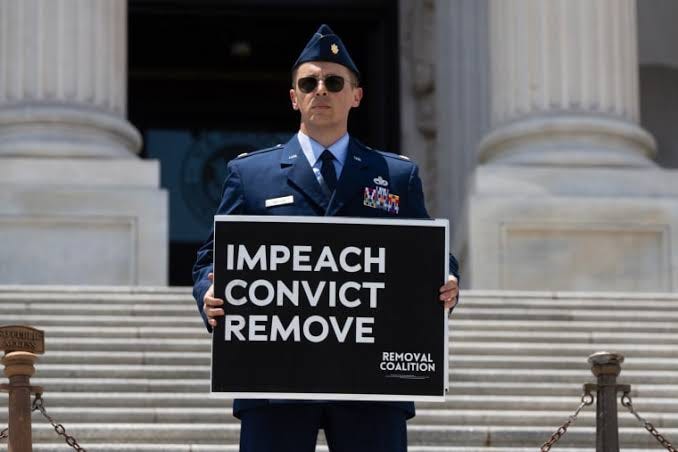
Maj. Jason Watson should not be turned into a flawless hero. Appearing at a political demonstration in uniform was a reckless decision. If the allegations are accurate, he also violated leave rules, disobeyed orders, and refused to wear his uniform when directed to report for duty. The Air Force has a legitimate interest in addressing that conduct.
But tactical bad judgment is not a blank check for constitutional abuse. The most consequential part of this case is not what Watson wore. It is the government’s decision to prosecute what he said.
That is where this becomes bigger than one major, one protest, or one president.
[Suggested paywall placement]
What Watson Is Actually Accused Of
According to reporting by Military.com, Reuters, and Stars and Stripes, charges were preferred against Watson under three UCMJ articles:
Three specifications under Article 88, contempt toward officials
Five specifications under Article 92, failure to obey an order or regulation or dereliction of duty
Two specifications under Article 133, conduct unbecoming an officer
“Preferral” means that charges have been formally sworn. It does not mean they have been referred to trial, and it certainly does not mean Watson has been convicted. The charges remain allegations, and he is entitled to the presumption of innocence and military due process.
The Article 88 allegations reportedly arise from three public episodes: a June interview with the Defenders of Our Republic Substack, his July 1 appearance in uniform on the Capitol steps, and an August 17 CNN interview. During the latter, Watson accused Trump of violating the Constitution and the law, engaging in corruption, and causing American deaths.
The Article 92 allegations are more conduct-based. They reportedly include violating restrictions on partisan political activity, improperly wearing his uniform at a political event, traveling to Washington in violation of leave rules, and later refusing an order to wear his uniform at work. The Article 133 specifications reportedly concern his Capitol appearance and CNN interview.
That separation matters. The government may have a strong case that Watson violated neutral rules governing uniforms, leave, duty status, and obedience. It does not automatically follow that his political criticism was criminal contempt.
Article 88 Is Not a General Ban on Criticizing a President
Article 88 applies only to commissioned officers. It prohibits “contemptuous words” against the president, vice president, Congress, the defense secretary, the service secretaries, the homeland security secretary, and certain state officials.
The government must establish that the accused was a commissioned officer, used words against a protected official, caused those words to become known to someone else, and that the words were contemptuous in themselves or in context.
The part too many headlines omit is the limiting language in the 2024 Manual for Courts-Martial. Emphatic adverse criticism made during political discussion may not be charged when it is not personally contemptuous. Private opinions ordinarily should not be charged either.
Article 88 is still an extraordinary law. The truth or falsity of the officer’s statement is legally immaterial. In other words, a statement can be factually accurate and still punishable if a military court finds it contemptuous. The maximum punishment for an Article 88 violation includes dismissal, forfeiture of all pay and allowances, and confinement for one year.
The crucial question is therefore not whether Watson criticized Trump. Military law expressly leaves room for criticism. The question is whether his language and the circumstances crossed the line from political condemnation into punishable personal contempt.
Calling a president a “failure” may sound insulting. Accusing a president of violating the Constitution and launching war without congressional authorization is also unmistakably a political and constitutional argument. And “Impeach. Convict. Remove.”—the message on Watson’s sign—is a demand that Congress use a lawful constitutional process. It is not a call for a military coup, violence, or refusal of a specific lawful order.
That does not resolve the legal issue. It explains why there is a real legal issue to resolve.
Watson Gave the Air Force a Conduct Case
The strongest argument against Watson is not Article 88. It is that he deliberately wrapped political dissent in the authority and imagery of his uniform.
The Defense Department’s own guidance permits active-duty members to express personal political opinions, but not as representatives of the armed forces. They may attend political events as spectators only when out of uniform. DoD Instruction 1325.06 also prohibits participation in certain off-post demonstrations, including when a service member is on duty, breaches law and order, or wears the uniform contrary to uniform regulations.
Watson apparently wanted the uniform to amplify his message. It did. It also made it easier for prosecutors to argue that the public could perceive official military endorsement of his position.
As a veteran, I would never advise an active-duty officer to take that route. The uniform belongs to the service and the country. It should not become campaign attire for either party.
Yet the Defense Department’s protest policy begins with another principle: a service member’s right of expression should be preserved to the maximum extent consistent with the Constitution, good order, discipline, and national security. The same policy states that criticism of government officials or policies is not, by itself, sufficient grounds to ban material.
The Air Force can enforce uniform and duty rules without transforming every harsh criticism of Donald Trump into criminal contempt. Article 92 can punish disobedient conduct. Article 88 should not become a convenient way to punish the viewpoint attached to it.
The History Shows Why Selective Enforcement Matters
Watson’s attorney says he is the first military major ever charged under Article 88. I have not found an independent official source proving that precise claim. I did find a history that makes it plausible—and exposes how unevenly this law has been used.
Henry Howe: Convicted for an Anti-Johnson Sign
In 1965, Army 2nd Lt. Henry Howe joined an anti-Vietnam War demonstration in El Paso while off duty and wearing civilian clothes. His signs denounced President Lyndon Johnson in personally contemptuous terms. Howe was convicted under Articles 88 and 133, and the military’s highest appellate court upheld the conviction in 1967.
Howe remains the foundational Article 88 case. It demonstrates just how far military jurisdiction can reach: off base, off duty, and out of uniform. It also comes from an era when courts gave the military sweeping latitude to restrict speech in the name of discipline.
Shane Sellers: A Major Who Called for Clinton’s Impeachment
The closest historical parallel may be Marine Maj. Shane Sellers. In 1998, Sellers wrote in Navy Times that President Bill Clinton was an “adulterous liar” and a criminal, and he argued that impeachment proceedings were warranted.
Sellers was the same rank as Watson. He used openly contemptuous language and advocated impeachment. Yet the Marine Corps did not court-martial him. According to an Associated Press report preserved by The Washington Post, he received verbal counseling and a nonpunitive letter of caution.
The cases are not identical. Sellers wrote a newspaper column; Watson protested in uniform and allegedly continued after being restricted and ordered to stop. Those differences may justify different treatment under Articles 92 and 133. They do not explain away the vast difference between a cautionary letter and pretrial confinement when both officers publicly urged a president’s impeachment.
Gary Stein: An Enlisted Marine Punished for Anti-Obama Speech
Article 88 did not apply to Marine Sgt. Gary Stein because he was enlisted. But in 2012, the Marine Corps administratively separated him with an other-than-honorable discharge after anti-Obama Facebook activity and statements about refusing presidential orders. Contemporary reporting described the case as a collision between military discipline and political speech.
Stein’s case shows that restrictions on partisan conduct have not been enforced only against the left. It also shows why precision matters. Criticizing policy is one thing. Publicly declaring that one will not follow orders is another—unless the speaker carefully distinguishes the military duty to refuse an unlawful order.
Stuart Scheller: Charged, Convicted—and Now Back in the Pentagon
After the chaotic 2021 withdrawal from Afghanistan, Marine Lt. Col. Stuart Scheller publicly attacked senior civilian and military leaders and continued after being ordered to stop. He spent time in pretrial confinement, was charged under Article 88 and five other UCMJ provisions, and pleaded guilty. His sentence included a reprimand and $5,000 in forfeited pay.
Scheller’s case initially looks like evidence of consistent enforcement. Then comes the political twist.
The current Pentagon now employs Stuart Scheller as deputy chief of staff to the under secretary responsible for personnel and readiness. The officer punished for publicly attacking leadership under President Biden has been welcomed back into government under President Trump, while Watson sits in confinement awaiting the disposition of charges for attacking Trump.
That contrast does not invalidate Watson’s charges. It does demolish any pretense that politics can be ignored when judging how dissent is punished, forgiven, or rewarded.
Mark Kelly: A Federal Court Draws a Line
The Trump administration also tried to censure and potentially reduce the retired rank and pay of Sen. Mark Kelly, a retired Navy captain, after he joined other lawmakers in reminding troops that they may refuse unlawful orders.
In February 2026, U.S. District Judge Richard Leon blocked that effort, finding that Kelly was likely to succeed on his First Amendment retaliation claim. The administration appealed, and a federal appellate panel later questioned the government’s position.
Kelly is retired and a sitting senator, so his constitutional protections are substantially different from Watson’s. Still, the episode reveals the same impulse: treating a reminder about constitutional and legal limits as disloyalty to the president.
Civilian Control Is Not Presidential Worship
Article 88 serves a legitimate democratic purpose. A republic cannot tolerate officers using military authority to intimidate elected leaders, mobilize troops for partisan objectives, or position the armed forces as an independent political power. The military must remain subordinate to civilian government.
But civilian control of the military does not mean personal submission to Donald Trump. The president is commander in chief; he is not the embodiment of the Constitution, and he is not beyond criticism.
Impeachment itself is a civilian constitutional remedy. Watson did not order troops to remove Trump. He called on Congress to act. However unwise his use of the uniform may have been, that difference is fundamental.
If Article 88 is enforced aggressively against officers who criticize Trump but leniently against officers who attacked Clinton or Biden-era leadership, it ceases to function as a neutral protection for civilian control. It begins to look like viewpoint enforcement: loyalty for one side, discipline for the other.
The danger is larger than Watson. Selective punishment teaches everyone in uniform a poisonous lesson—not “remain nonpartisan,” but “learn which politics the chain of command will tolerate.” That is how an apolitical military is slowly converted into a politically obedient one.
My Judgment as an Air Force Veteran
I do not stand at a cautious distance from Watson’s central conclusion. I agree with him 100 percent: Donald Trump should be impeached by the House, convicted by the Senate, and removed from office.
I believe Trump has repeatedly violated the Constitution, abused the powers of the presidency, and demonstrated that he is unfit to serve as commander in chief. Watson was right to call for Congress to use the constitutional remedy the founders provided for precisely such a crisis. On that fundamental question, there is no daylight between his position and mine.
My concern about Watson’s actions is tactical, not moral or constitutional. I would not have advised an active-duty officer to make a political demonstration in uniform, and he was not free to disregard lawful orders simply because he believed his cause was righteous. If the evidence proves violations of neutral duty, leave, or uniform regulations, the Air Force may address them through a fair and proportionate process. None of that makes his demand for Trump’s impeachment wrong.
Watson understood that he could lose his career, his retirement, and his freedom. He spoke anyway. I will not pretend to be neutral about the courage that required or the truth he was trying to force this country to confront.
I am therefore far more troubled by an Article 88 prosecution that risks making “contempt” synonymous with forceful opposition to Trump than I am by Watson’s call for impeachment. That concern becomes even more serious when the prosecution unfolds amid a broader campaign to punish disfavored military and veteran speech while rewarding politically useful dissenters.
Good order and discipline are indispensable. So are proportionality, consistency, and due process. An institution that demands accountability from a major must demand integrity from those deciding his fate.
Watson is presumed innocent. Preferral is not referral. Referral is not conviction. Pretrial confinement is not supposed to be punishment. The Air Force must prove every element of every offense and show that its treatment of him is grounded in military necessity—not presidential sensitivity.
What Happens Next
The charges will be reviewed to determine whether they should proceed to court-martial. If required, an Article 32 preliminary hearing will assess probable cause and make recommendations concerning disposition. A convening authority will then decide whether to refer charges to trial, dispose of them another way, or dismiss them.
The public should watch several questions:
What exact words support each Article 88 specification?
Which allegations concern neutral misconduct, and which concern political viewpoint?
What orders was Watson given, when were they issued, and were they lawful?
Why was continued pretrial confinement considered necessary?
How does the proposed disposition compare with Sellers, Scheller, and other political-speech cases?
Will the Air Force release enough information to allow meaningful public scrutiny without compromising Watson’s right to a fair trial?
Those are not anti-military questions. They are the questions of citizens who want military justice to remain worthy of its name.
Final Word
The uniform imposes obligations civilians do not carry. It demands restraint, discipline, and obedience to lawful orders. Maj. Jason Watson knew that and appears to have deliberately accepted the consequences of crossing several well-marked lines.
But the uniform is not a gag, Article 88 is not a presidential shield, and military justice must never become a partisan weapon.
Donald Trump is entitled to the obedience the Constitution gives the commander in chief. He is not entitled to personal reverence. No president is.
The Air Force can punish proven misconduct without criminalizing constitutional dissent. Whether it can still tell the difference may be the most important question in Jason Watson’s case.
How We Fight Back
We defend an apolitical military by applying the rules evenly—regardless of whether the president is a Democrat or Republican and regardless of whether we agree with the service member’s politics.
We insist on due process, transparent proceedings, and proportionate punishment. We separate uniform violations and disobedience from protected political criticism. We demand congressional oversight when military law appears to be used selectively. And we refuse the authoritarian lie that criticism of a president is betrayal of the country.
Most of all, we remember what every service member’s oath makes clear: loyalty to the Constitution is not disloyalty to America. It is the highest form of loyalty America asks.
Paid subscriptions support deeply sourced, independent analysis that refuses partisan propaganda, lazy false equivalence, and silence in the face of democratic erosion.
I’m sorry that Major Watson is looking at prosecution for violating several rules of conduct, especially when 47 has violated many more serious and consequential rules of conduct.
It was an important vision for me to see an American soldier peacefully protesting this criminal administration.