

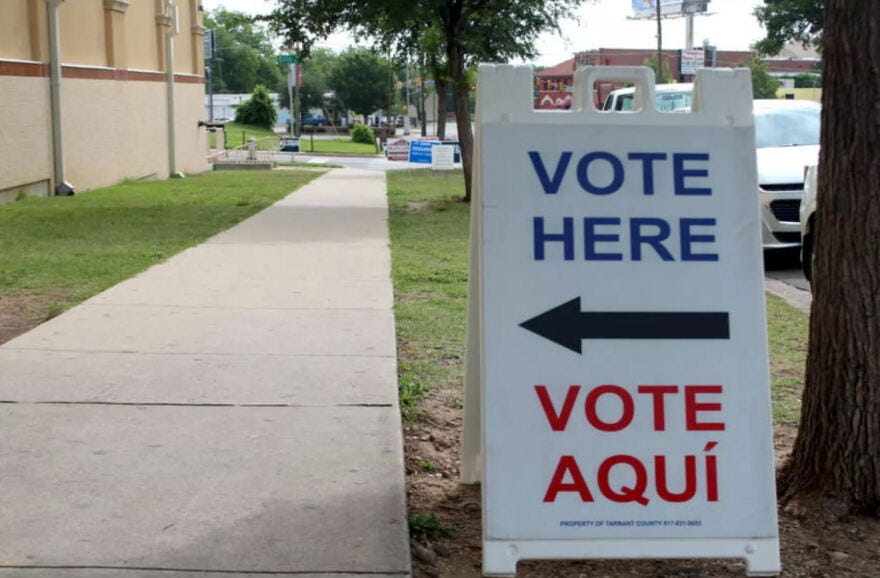
By Dr. John Petrone
There is a number missing from some of the most inflammatory coverage of what is happening in Tarrant County, Texas.
224.
That is how many Election Day polling locations are actually in the proposal county commissioners are scheduled to consider Tuesday.
The original plan was considerably more drastic: cut Election Day locations from 316 in the 2022 midterm to 176 in 2026 — eliminating 140 sites, a reduction of roughly 44%. Early-voting sites would have dropped from 50 to 42.
The public erupted. Hundreds of people descended on the Aug. 4 Commissioners Court meeting. The meeting became so contentious that the chamber was cleared, and commissioners — Republicans and Democrats alike — ultimately agreed that 176 locations were too few and postponed the vote.
The county elections administrator went back to the drawing board.
The revised proposal is better.
It is not small.
Tarrant County would still operate 92 fewer Election Day polling places than it did four years ago.
That is nearly three out of every ten Election Day locations gone.
And that is the proposal now confronting one of the fastest-growing and most politically consequential counties in Texas.
[Suggested paywall placement]
What Tarrant County Is Actually Proposing
The current plan calls for:
224 Election Day voting locations, compared with 316 in the 2022 midterm.
47 early-voting locations, compared with 50 in 2022.
48 more Election Day locations than the original 176-site proposal.
Five more early-voting locations than the original 42-site proposal.
The revised plan also reportedly places Tarrant County 54 Election Day sites above the statutory minimum. County officials say they prioritized accessibility, proximity to public transportation and efficiency.
Those facts matter.
So does another one: the original 140-site cut is no longer the proposal being voted on.
That distinction is important because there is already enough genuinely troubling material here without exaggerating it.
A democracy should be scrutinized with facts, not improved with misinformation.
The County Has a Case. It Should Be Examined.
Tarrant County Elections Administrator Clint Ludwig has argued that operating fewer locations can make sense because Tarrant uses a countywide vote-center system. A registered voter is not restricted to one assigned neighborhood precinct; the voter can cast a ballot at any Election Day vote center in the county.
That changes the equation.
County officials also point to polling locations that attract very few voters, the cost of staffing those sites and the increasingly difficult task of recruiting election workers.
County Judge Tim O’Hare, a Republican, opposed the original 176-site proposal as too severe. Commissioner Manny Ramirez, also a Republican, went further, saying he preferred maintaining the 2022 number unless particular sites were unavailable or unwilling to host voting.
O’Hare and Commissioner Matt Krause have argued that taxpayers should not have to operate redundant sites located near each other or locations that attract extremely few voters. The lowest-turnout site in 2022, according to the Fort Worth Star-Telegram, served 37 voters on Election Day.
That is a legitimate administrative argument.
But it does not end the discussion.
The fundamental question is not whether some polling locations can reasonably be consolidated.
It is whether eliminating 92 of them at once is supported by evidence showing that voters will retain roughly equivalent practical access to the ballot.
That requires more than counting buildings.
Why Voting-Rights Groups Are Alarmed
The Legal Defense Fund, Campaign Legal Center, ACLU of Texas, Texas Civil Rights Project, Asian American Legal Defense and Education Fund, Common Cause Texas and other organizations have urged commissioners to reject the reduced map.
Their argument is not simply that fewer polling places automatically equal voter suppression.
They argue that the location of the closures matters, particularly if the burden falls more heavily on Black, Latino and Asian American communities.
The Legal Defense Fund says the revised proposal would eliminate nearly 30% of Tarrant County’s Election Day polling locations and contends that voters of color would experience disproportionate effects through additional travel, lines and time away from jobs, school, child care and other responsibilities.
That claim should be tested against the final map and the county’s data.
It should not be dismissed because 224 sounds like a large number.
A county can have hundreds of voting sites and still distribute them badly.
Conversely, reducing locations does not by itself establish discriminatory intent.
Geography matters. Transportation matters. Population density matters. Historical turnout matters. Disability access matters. Wait times matter. And where the eliminated locations are concentrated matters.
That is the analysis voters deserve before the map becomes final.
The Jim Crow Comparison Needs Precision — And History Still Matters
Calling every election-administration dispute “Jim Crow” risks flattening history.
Jim Crow voting suppression involved poll taxes, literacy tests, white primaries, intimidation, violence and deliberately constructed barriers aimed at preventing Black citizens from exercising political power.
Closing an underused modern vote center is not inherently the same thing.
But Texas also carries a history that makes complacency impossible.
Until the Supreme Court’s 2013 decision in Shelby County v. Holder, Texas was among the jurisdictions required under Section 5 of the Voting Rights Act to obtain federal “preclearance” before implementing covered voting changes. Shelby County invalidated the statutory coverage formula, meaning previously covered jurisdictions generally no longer had to obtain that advance federal approval.
What followed became the subject of extensive scrutiny.
A 2019 Leadership Conference Education Fund study reported that Texas had closed 750 polling places since Shelby, the largest number among states examined in the report. Some of those reductions accompanied the move toward countywide vote centers, which gave voters greater flexibility about where they could cast ballots — an important qualification.
That history does not prove that Tarrant County’s 2026 proposal is racially motivated.
It explains why a large-scale polling-place reduction in Texas is never just an accounting exercise.
This Is Not Happening in a Vacuum
Tarrant County should not be portrayed as proof that Republican states everywhere are suddenly closing polling places. The evidence does not support that claim.
But it would be equally misleading to pretend this dispute exists in isolation.
The Republican Party of Texas itself adopted a 2026–2028 election agenda calling for something far more sweeping than the current Tarrant County proposal: single-day, precinct-only voting, with counties given discretion to consolidate precinct polling locations. The platform also calls for sharply restricting mail voting and imposing additional identification and registration requirements.
Read that again.
The official governing party of Texas is advocating a system with less flexibility about when people vote and less flexibility about where they vote.
That does not prove Tarrant County officials are carrying out a coordinated state-party voter-suppression plan. The county currently uses vote centers, and its proposal is an administrative consolidation rather than implementation of the state GOP platform.
But the broader philosophy is impossible to ignore.
At a moment when one major Texas county is debating whether it needs 92 fewer Election Day voting locations, the state’s dominant political party is formally advocating a future in which voters would be tied to precinct locations and Election Day itself.
Tarrant County may therefore be more than a local fight over operating costs.
It may be an early look at a much larger argument over what voting in Republican-led states should look like.
Arizona provides another warning — although one that requires some important qualification.
Earlier this year, Republican lawmakers there advanced proposals that would have eliminated countywide voting centers and pushed voters back toward precinct-assigned polling places. Arizona Secretary of State Adrian Fontes warned that the change could reduce voting flexibility, pointing to confusion that occurred when Dallas County moved voters toward precinct-specific locations.
But Arizona’s final HCR 2001 was substantially rewritten. The version ultimately sent to voters does not contain the earlier prohibition on voting centers. It instead focuses on government-issued identification, citizenship requirements, election administration and on-site ballot tabulation, with its major provisions applying beginning in 2028 if voters approve it.
That distinction matters.
We should not accuse Arizona of doing something it ultimately did not do.
What the episode shows is that proposals restricting flexible vote-center systems are very much circulating within Republican election-policy debates.
Florida offers another useful comparison. Sarasota County consolidated and reorganized precincts ahead of the 2026 elections, leaving the county with 98 precincts and 83 Election Day polling locations. Election officials say the changes were driven by growth, capacity, annexation and efficiency, and affected voters were directly notified of new polling locations.
That is exactly why every polling-place reduction should not automatically be labeled voter suppression.
Some consolidations have legitimate administrative explanations.
The question is whether officials can demonstrate that the changes preserve reasonable access — and whether the burdens are distributed fairly.
The emerging story is therefore more complicated, and in some ways more troubling, than “Republicans are closing polling places.”
What we are seeing is a broader movement within Republican election policy toward less geographic flexibility, tighter mail-voting rules, stricter identification requirements and greater emphasis on precinct-based Election Day voting.
The mechanisms differ.
The direction deserves scrutiny.
And Tarrant County is now one of the places where that debate has become impossible to ignore.
Then There Is the Timing
Tarrant County is not some sleepy jurisdiction preparing for an uncontested municipal election.
It has more than 2 million residents and has become one of Texas’ most closely watched political counties.
And Texas has a genuinely competitive U.S. Senate election underway between Republican Attorney General Ken Paxton and Democratic state Rep. James Talarico.
Recent polling does not point in only one direction. The University of Texas/Texas Politics Project had Talarico ahead 42%-39% in its August survey, while Emerson’s August poll had Paxton ahead 47%-46%. Other recent surveys in the UT tracker showed narrow Talarico leads. In other words, this is a competitive race, not a foregone conclusion.
Talarico has publicly opposed the Tarrant County reduction, arguing it could produce longer drives, longer waits, confusion and lower participation. Paxton’s campaign did not respond to the Associated Press when asked for comment on the polling-place controversy.
But competitive elections themselves do not prove improper motive.
That is precisely why officials should be able to defend the map without asking the public to trust anyone’s partisan intentions.
Show the data.
The Most Important Question Isn’t Republican or Democrat
There is a temptation to reduce this to the simplest partisan narrative imaginable:
Republicans control the county.
A competitive election is coming.
Polling places are being cut.
Therefore, Republicans are suppressing votes.
There is an inconvenient fact for that theory.
The 176-location proposal originated with Tarrant County’s elections administrator, whose position is nonpartisan, and commissioners of both parties rejected that version as too drastic. O’Hare himself publicly called 176 sites insufficient.
That does not establish that the revised 224-site plan is good policy.
It does mean that accusations of deliberate partisan suppression require evidence beyond the raw fact that Republican officials control the Commissioners Court.
The stronger scrutiny is simpler:
Can county officials demonstrate that a fast-growing county can remove 92 Election Day voting locations without meaningfully increasing the burden on voters?
If they can, the evidence should be made public.
If they cannot, taxpayers saving money is not a substitute for that missing evidence.
This Is Where the Debate Should Get Very Specific
Before commissioners approve the map, the public should be able to see clear answers to basic questions.
Which 92 locations used in 2022 are disappearing?
How many voters used each one?
How far will voters in those areas now travel to the nearest alternative?
What are the expected Election Day wait times?
How many registered voters will each remaining vote center potentially serve?
Are reductions distributed proportionately across neighborhoods of different income levels and racial demographics?
How many locations are accessible by public transportation?
What happens if turnout is substantially higher than administrators project?
What is the actual dollar savings?
And perhaps most importantly:
What measurable standard will Tarrant County use after the election to determine whether the consolidation worked?
Those are administrative questions, not ideological ones.
They also happen to be the questions that determine whether “efficiency” means making government work better — or simply making citizens work harder to reach it.
What Happens Next
The Tarrant County Commissioners Court is scheduled to consider the polling-location plan on Tuesday, Sept. 1. The county itself lists that Commissioners Court meeting on its official calendar.
Early voting is scheduled for Oct. 19 through Oct. 30.
Election Day is Nov. 3.
Whatever the commissioners decide, voters need a definitive map quickly.
Repeatedly changing polling locations shortly before an election creates its own problem: confusion.
Even a perfectly lawful polling-place consolidation can become a practical voting obstacle if residents arrive at a familiar school, church or community center and discover that the place where they have voted before is no longer a polling location.
That makes public communication part of the election infrastructure, not an afterthought.
Final Word
The story in Tarrant County has already changed once.
Public scrutiny took an original proposal to slash Election Day locations from 316 to 176 and pushed officials back to 224.
That matters.
It proves public attention can change government decisions.
But 224 does not make the controversy disappear.
The county would still operate 92 fewer Election Day locations than it did during the last midterm election.
And now we know something else.
This debate is unfolding while the Republican Party of Texas is openly advocating a future of single-day, precinct-only voting with the possibility of consolidated precinct locations. Similar efforts to restrict vote-center flexibility have surfaced elsewhere, including Arizona, even when they did not ultimately become law.
That does not prove a conspiracy.
It does establish a political direction worth watching.
The argument is increasingly about something much bigger than whether one community center receives enough voters to justify the cost of keeping it open.
It is about what kind of voting system Americans should have.
One designed around making participation as accessible and flexible as reasonably possible?
Or one that increasingly requires voters to accommodate the system?
Tarrant County officials say fewer, better-positioned vote centers can save resources without preventing anyone from voting.
Civil-rights organizations say the closures could place unequal burdens on communities of color.
Both claims are testable.
Show us the numbers. Show us the map. Show us who loses a polling place, how much farther they must travel, what happens to expected wait times and exactly how much money taxpayers save.
If the case for closing 92 polling places is sound, officials should have no difficulty proving it.
If it cannot survive that scrutiny, “efficiency” is not a sufficient answer.
And Americans outside Texas should pay attention.
Because the most important question raised by Tarrant County may not ultimately be whether 92 polling places disappear in one Texas county in 2026.
It may be whether what happens there becomes a model for what comes next.
If this kind of reporting and analysis is useful to you, consider becoming a paid subscriber. Your support gives me the time to go beyond the headline, check competing claims, track the underlying documents and tell you what the story actually means.
Most of my work will continue reaching everyone. But paid subscribers will also sometimes receive a deeper look at a topic first covered in a public article — additional reporting, context, documents and analysis that take the story beyond the original piece.
If you’re already a paid subscriber, thank you. If you’ve been reading for free and wondering when to join, this would be a good time.
Oregon around 2000 and Utah more recently have both gone to all mail voting. Saves money for counties and time for voters. I don’t understand why more states haven’t moved in that direction. Unless some think they benefit from lower turnout rates?
F. Texas snd all orher Republican led staes. They're just scared they will no longer be in power if all people can easily vote and all the votes cast are counted properly.