

By Dr. John Petrone
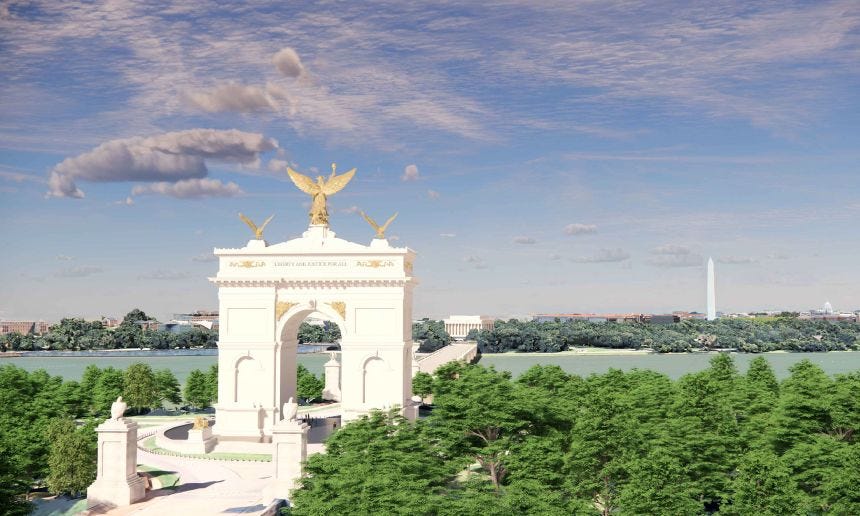
Interior Secretary Doug Burgum says excavation will begin within the next two weeks for President Donald Trump’s proposed 250-foot triumphal arch at Memorial Circle, between the Lincoln Memorial and Arlington National Cemetery.
That announcement matters because the project still does not have final approval from the National Capital Planning Commission, the National Park Service says its own environmental finding is not a final project approval, the historic-preservation process remains incomplete, and a lawsuit brought on behalf of military veterans is still pending.
In other words, this is no longer simply a debate over whether Washington needs another monument.
It is becoming a test of what federal review, historic-preservation law, congressional authority and judicial oversight actually mean when physical work begins before all of those questions have been resolved.
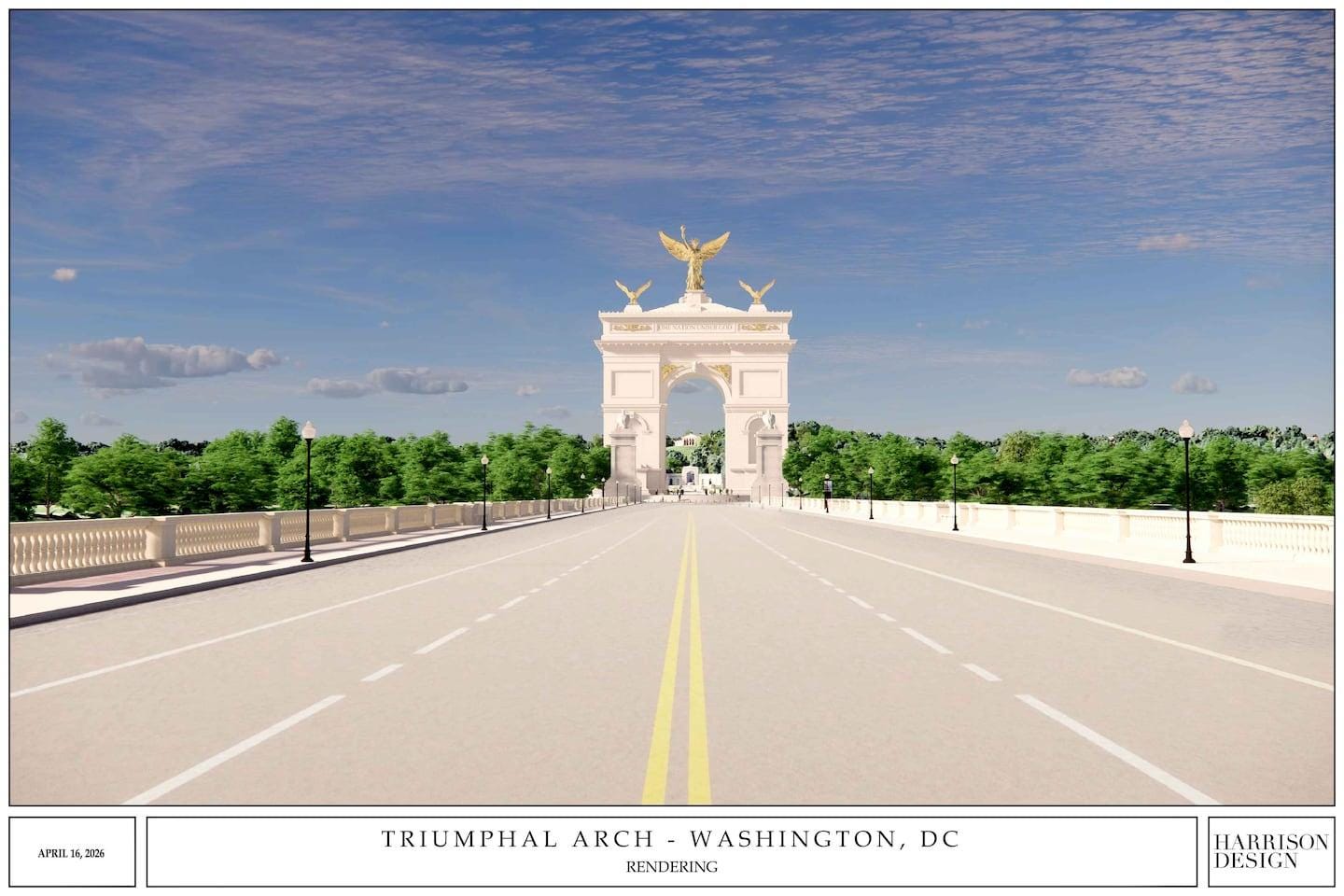

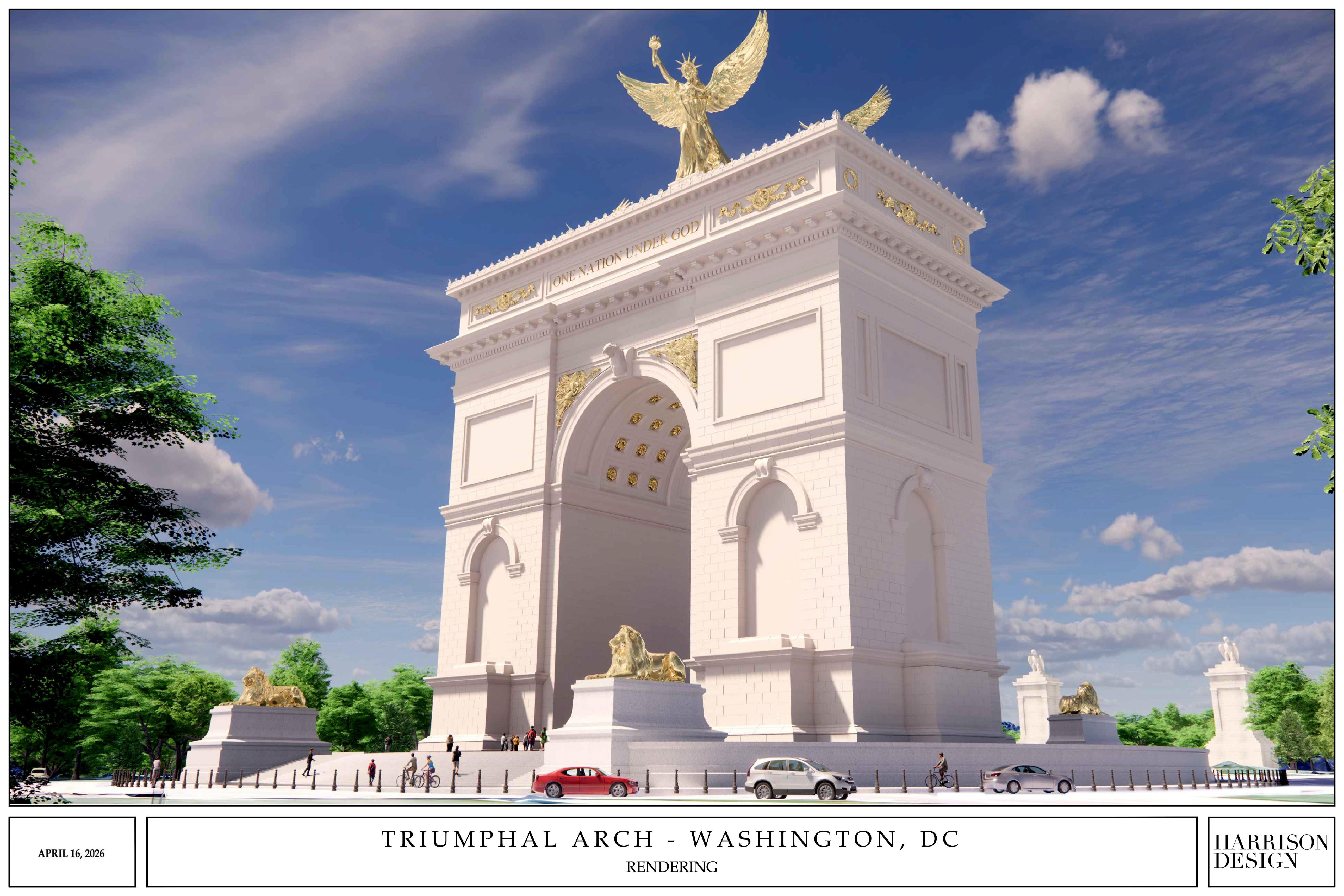
Renderings of the proposed triumphal arch show the scale of the structure planned for the Memorial Circle corridor between the Lincoln Memorial and Arlington National Cemetery.
[PAID SUBSCRIBER BREAK]
THE ARCH IS REAL — AND IT IS ENORMOUS
The proposed structure is not a modest gateway.
At 250 feet, it would stand more than twice the height of the approximately 99-foot Lincoln Memorial and roughly 86 feet taller than the Arc de Triomphe in Paris. The design includes monumental classical architecture, gold ornamentation, eagles and a winged figure crowning the structure.
Trump has described the project as part of the celebration of America’s 250th anniversary.
The administration’s case is that Memorial Circle has long been contemplated as a location for monumental treatment. Burgum has pointed to historical planning for the Arlington Memorial Bridge corridor, and Trump has argued that existing federal authority is sufficient to proceed without new congressional authorization.
Opponents dispute that legal interpretation.
That disagreement is now in federal court.
WHAT HAS ACTUALLY BEEN APPROVED?
This is where the story gets more complicated than the renderings.
The Commission of Fine Arts approved the arch design in May. That was a significant step, though the process leading to it included questions about the structure’s scale and ornamentation. Trump rejected a suggestion to substantially reduce its height.
The National Capital Planning Commission, however, has given only preliminary approval.
CNN reported that the earliest the commission could issue final approval is October 1, when it is next scheduled to meet.
Then there is the National Park Service.
The NPS has completed an Environmental Assessment and issued a Finding of No Significant Impact, or FONSI.
But the agency itself says something important that should not be lost in the political argument:
the FONSI “does not constitute a final decision or approval for the project.”
The Park Service says the Section 106 historic-preservation process has not yet been completed, and it has not yet issued the separate decision document or non-impairment determination that would normally accompany final action.
That is not an interpretation offered by an opponent of the president.
That is the National Park Service describing the status of its own review.
THE HISTORIC-PRESERVATION REVIEW FOUND A PROBLEM
The National Park Service has also completed a revised assessment under the National Historic Preservation Act.
Its conclusion was not that the arch would be invisible or insignificant.
The agency found that the proposed undertaking would have an “adverse effect” on one or more historic properties within the affected area.
That matters because Memorial Circle is not an isolated traffic island.
It is part of a deliberately composed monumental landscape linking the Lincoln Memorial, Arlington Memorial Bridge, the Potomac River corridor, Arlington National Cemetery and Arlington House.
The Park Service describes Memorial Circle itself as a formally designed part of the George Washington Memorial Parkway and notes that the broader landscape includes important cultural, natural and recreational resources.
The argument over the arch is therefore partly about architecture.
But it is also about views, scale, historical context and the relationship among existing national memorials.
THE VETERANS’ LAWSUIT
Three veterans and a historian have challenged the project in federal court in Lemmon v. Trump.
Public Citizen, which represents the challengers, says the lawsuit seeks to stop construction of the arch because the plaintiffs contend it would interfere with the symbolic view connecting Arlington National Cemetery and the Lincoln Memorial.
The court previously required the government to provide 14 days’ notice before construction begins.
Burgum’s September 3 announcement that excavation would begin within two weeks effectively put that timetable into motion.
The administration maintains that the plaintiffs lack standing and that historical legislation connected to the Arlington Memorial Bridge provides authority for the project.
The challengers argue that Congress never authorized this specific monument and that required federal review has not been completed.
Those are unresolved legal claims.
No final court judgment has yet decided the underlying legality of the arch.
THEN THE SUPREME COURT CHANGED THE LANDSCAPE
The timing of Burgum’s announcement is especially significant because of what happened days earlier with another Trump construction project.
The Supreme Court allowed work to continue on the president’s White House ballroom project.
But there is a distinction worth emphasizing.
The Court’s majority did not rule that the ballroom itself was lawful. Instead, the decision centered on whether the preservation organization challenging the project had Article III standing to obtain the requested injunction.
Chief Justice John Roberts joined the Court’s three liberal justices in dissent and wrote that the ballroom construction was “likely unlawful.”
The majority nevertheless allowed construction to proceed because it concluded that the government was likely to prevail on the standing question.
That distinction is crucial.
A court can conclude that a plaintiff lacks standing without deciding that the government conduct being challenged is legal.
WHY THAT RULING MATTERS FOR THE ARCH
The Justice Department is now invoking the ballroom decision in the arch litigation.
Administration lawyers argue that the veterans challenging the arch have a standing problem similar to the preservation group in the ballroom case. CNN reported that DOJ told the court that the plaintiffs cannot establish standing merely from their desire to maintain particular views of Arlington House or the Lincoln Memorial.
That could make the arch litigation less about whether every required approval was obtained and more about whether anyone challenging the project can demonstrate the kind of individualized injury federal courts require.
That is an important legal distinction.
A lawsuit can fail because the plaintiff is not legally entitled to bring it even if a court never reaches the underlying statutory dispute.
And that is why the Supreme Court ballroom ruling may have consequences far beyond one construction site.
THE PATTERN
The arch is not occurring in isolation.
Trump’s second-term effort to reshape prominent spaces in Washington has included the White House ballroom complex, the proposed overhaul of the East Potomac Golf Links, renovations elsewhere in the capital and now the Memorial Circle arch.
Each project has its own statutes, facts, approvals and litigation.
They should not simply be treated as one legal case.
But a procedural pattern is emerging: construction or site activity moves quickly while opponents attempt to use preservation statutes, administrative review and federal courts to slow or stop it.
The ballroom litigation demonstrated one vulnerability in that strategy: standing.
The arch case may determine whether veterans who regularly visit the Arlington-Lincoln Memorial corridor can clear that hurdle.
And the East Potomac Park litigation presents another version of the same broader dispute over how much review must occur before substantial changes are made to federal public spaces.
THE EAST POTOMAC PARALLEL
The planned overhaul of East Potomac Golf Links has also produced litigation over preservation and environmental procedures.
The National Park Service previously represented in court that it would complete compliance with applicable laws and regulations before authorizing construction of the golf-course renovation.
The issue gained additional attention after more than 60 trees were removed around the golf-course area.
There was considerable misinformation about that work online: FactCheck.org found that claims that 60 historic cherry trees had been cut down were false. Reporting supported the removal of more than 60 trees overall, but only one cherry tree was clearly documented.
That distinction matters.
There are enough consequential questions surrounding these projects without exaggerating what the evidence shows.
EVEN THE FAA IS INVOLVED
There is another unusual piece of the arch review: aviation.
The proposed structure would rise more than 200 feet near the heavily traveled airspace surrounding Reagan National Airport.
CNN reported that a preliminary Federal Aviation Administration study concluded that the arch would not create an aviation hazard but recommended red obstruction lights on the structure.
That may sound like a minor technical detail.
But imagine the visual effect.
A monumental classical arch positioned on one of the most historically significant ceremonial axes in the United States could also require aviation warning lights because of its height.
That illustrates just how large this structure would be.
WHAT THE ADMINISTRATION SAYS
The administration does have a substantive case for the project that should be presented accurately.
Trump and Burgum describe the arch as a long-delayed completion of the monumental planning surrounding Arlington Memorial Bridge and as an architectural commemoration of the United States’ 250th anniversary.
They argue that Memorial Circle was historically intended to receive monumental treatment.
Burgum has also noted that many major world capitals feature triumphal arches and says Washington should have a comparable landmark.
Supporters also note that the Commission of Fine Arts has approved the design.
Those are real arguments.
The unresolved question is whether historical intent to monumentally develop the location is equivalent to legal authorization for this particular 250-foot arch, under present-day federal law and review requirements.
That is precisely what the litigation and remaining administrative process are testing.
WHAT THE OPPONENTS SAY
Opponents include preservation groups, Democratic members of Congress and military veterans.
Their arguments are not identical.
Some focus on the scale and aesthetics.
Others focus on the Arlington viewshed.
Others contend that Congress must explicitly authorize the structure.
Representative Don Beyer of Virginia introduced the Arlington National Cemetery Viewshed Protection Act, which would prohibit construction of such an arch in Lady Bird Johnson Park and bar federal funding for it. The proposal reflects one congressional response to the administration’s position that additional authorization is unnecessary.
The bill itself does not settle what current law requires.
That remains disputed.
THE MOST IMPORTANT DOCUMENT MAY BE THE BORING ONE
The architectural renderings are dramatic.
The political rhetoric is dramatic.
The lawsuits are dramatic.
But the most revealing document may be a fairly dry National Park Service webpage.
It says:
The environmental assessment is finished.
The FONSI is finished.
But the FONSI is not final approval.
The Section 106 process is unfinished.
The decision document is unfinished.
The non-impairment determination is unfinished.
And nevertheless, the secretary of the Interior says excavation is about to begin.
That is the factual tension at the center of this story.
WHY “BREAKING GROUND” MATTERS
Government reviews are designed to take place before decisions become effectively irreversible.
That does not mean every lawsuit must halt every federal project.
It does mean that the sequence matters.
The National Capital Planning Commission can still review the final proposal.
The Section 106 process can still continue.
A federal court can still consider the veterans’ suit.
Congress can still legislate.
But once excavation begins, the dispute moves from plans and drawings into physical alteration of the site.
That creates a fundamentally different practical landscape, regardless of how the legal arguments are ultimately resolved.
THIS IS ALSO A SEPARATION-OF-POWERS STORY
The deeper dispute is not whether someone likes classical arches.
It is about who decides what happens to federal civic space.
The executive branch controls agencies and federal land.
Congress controls legislation and appropriations.
Independent commissions have statutory planning and design roles.
Preservation statutes require procedural review.
Federal courts decide cases brought by plaintiffs who can establish standing.
The arch controversy sits at the intersection of all of them.
And the ballroom ruling demonstrates something especially consequential: a court may conclude that the person challenging executive action cannot sue without ever finally deciding whether the executive action itself complied with the law.
That distinction deserves much more public attention than the architecture.
THE LINE WE DRAW
The legal line is still being drawn.
One side argues that longstanding federal authority, Interior Department control of the land and completed portions of the review process permit the project to advance.
The other argues that congressional authorization and unfinished preservation and planning requirements prevent construction from lawfully proceeding.
The National Park Service itself says final approval has not yet occurred.
The National Capital Planning Commission has not issued final approval.
The historic-preservation process remains unfinished.
The veterans’ lawsuit remains pending.
And excavation is now expected within two weeks.
Whatever ultimately happens to the arch, those facts make this more than a story about a monument.
It is a story about whether the procedural safeguards surrounding some of the most symbolically important public land in America can meaningfully operate when the machinery begins moving before the process is complete.
If you found this factual breakdown useful, please restack it.
P.S. The next scheduled National Capital Planning Commission meeting is October 1, which CNN reports is the earliest the commission could provide final approval for the arch.
P.S.S. Release all of the Epstein files now!
Why does the United States want to build a 250 foot monument to honor a draft dodger who said the military were loosers because Trump couldn’t understand why they serve the country. He asked “what is in it for them?”
His shadow over the graveyard is a disservice to the military dead.
Triumphal Arch? Just what triumph are we celebrating? I see no triumph anywhere.