

By Dr. John Petrone
Veteran. Educator. Citizen Defender of Democracy.
Something unusual is happening behind the public warfare of Washington.
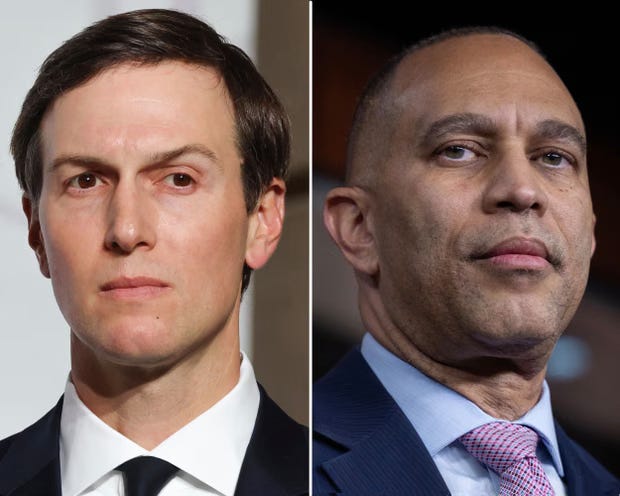
While Donald Trump and congressional Republicans continue portraying Democrats as extremists, Jared Kushner — Trump’s son-in-law, longtime adviser and one of the people with unusually durable access to his political orbit — recently sat down privately with House Democratic Leader Hakeem Jeffries in New York.
And this is no longer merely a report bouncing around partisan media.
CBS News confirmed the meeting Monday. ABC News and the Associated Press have also reported it. The conversation reportedly included housing, immigration and the cost of living, and the Los Angeles Times reported an additional detail that may be even more significant: Kushner suggested that Jeffries meet next with White House Chief of Staff Susie Wiles.
That sounds less like two old acquaintances having coffee and more like the beginnings of a communications channel.
And with the November 3 midterms barely ten weeks away, the timing matters.
This Meeting Is About More Than “Common Ground”
There is an innocent explanation for the conversation.
Jeffries and Kushner have worked together before. During Trump’s first administration, they were involved in negotiations surrounding criminal-justice reform. Political leaders are supposed to talk to people with whom they disagree, and Democrats will have to deal with the Trump administration regardless of which party controls Congress.
That argument deserves to be taken seriously.
But politics is also about incentives.
Kushner does not hold a formal White House position, yet multiple outlets describe him as a continuing outside adviser to Trump. And Jeffries is not simply another Democratic congressman. If Democrats capture the House, Hakeem Jeffries is overwhelmingly positioned to become Speaker.
Which changes the significance of the meeting considerably.
The conversation may therefore be both things at once: an attempt to find legitimate areas of cooperation and political contingency planning for a government in which Trump can no longer depend on a Republican-controlled House.
That distinction matters.
Because elsewhere in today’s news, Republicans are behaving like a party that knows November could go badly.
The Other Stories Today Tell the Same Story
Reuters reported Monday that Republicans are turning their September convention in Dallas into what amounts to both a rally and a rescue mission, as GOP strategists confront voter frustration over the economy, the Iran war and Trump’s political standing heading into the midterms.
The Wall Street Journal, meanwhile, highlighted Virginia’s 2nd Congressional District as one of the races that could determine control of the House. Republicans currently hold only a narrow 219–212 advantage, and the broader political environment includes dissatisfaction over prices, tariffs, energy costs and the economy.
Even the Cook Political Report’s current House ratings illustrate how little room Republicans have for error. As of its August 13 update, Cook classified 205 seats as Solid/Likely/Lean Democratic and 211 as Solid/Likely/Lean Republican — leaving the remaining seats in the genuinely competitive territory where control of the chamber will be decided.
In other words, Kushner did not reach out to Jeffries in a political vacuum.
He did it while the House majority is very much in play.
Paid subscribers get the full breakdown: why Susie Wiles matters, what a Speaker Jeffries would mean for Trump, the Democratic backlash to the meeting, and why cooperation and aggressive oversight could be happening simultaneously.
The Detail I Would Watch Most Closely
The most revealing part of this story may not be the Jeffries-Kushner meeting itself.
It is the reported suggestion that Jeffries speak with Susie Wiles.
Kushner can plausibly be described as an informal intermediary. Wiles cannot. She is Trump’s White House chief of staff.
If that follow-up happens, the significance changes.
It would indicate that people around Trump are not merely maintaining personal relationships. They would be establishing a working relationship with the man who could soon control one chamber of Congress.
That does not prove the White House expects Republicans to lose.
But it is exactly the kind of relationship-building a rational administration would undertake if losing the House had become a serious possibility.
And there is another clue.
Trump himself has recently changed his rhetoric toward Jeffries.
ABC reported that after years of personally attacking the Democratic leader, Trump told Punchbowl News this month that Jeffries was a “nice guy” and suggested that the two could get along.
Maybe Trump suddenly discovered bipartisan statesmanship.
Or maybe political reality has a way of creating newfound respect.
Democrats Have Reason to Be Suspicious
The meeting has also created genuine discomfort on the Democratic side.
TIME and The Guardian reported Monday that some Democrats and Trump critics questioned why Jeffries would privately engage with Kushner, particularly given continuing scrutiny surrounding Kushner’s business interests and his influence inside Trump’s orbit.
That skepticism is understandable.
If Democrats retake the House, Jeffries will face competing responsibilities that will be difficult to reconcile.
A Democratic House will be expected to legislate where legislation is possible.
It will also be expected to conduct serious congressional oversight.
Those responsibilities are not mutually exclusive.
Congress can negotiate a housing bill on Tuesday and issue subpoenas on Wednesday.
In fact, another recent Wall Street Journal report says Democrats are already preparing potential investigations involving Trump and his allies if they win the House, including questions surrounding business dealings, immigration enforcement, the Iran conflict and possible conflicts involving Trump-family financial interests.
That is why portraying the Kushner meeting as either capitulation or bipartisan harmony is premature.
It could be neither.
It could simply be preparation for divided government.
Housing, Immigration and Affordability Were Not Random Choices
Look closely at the three subjects reportedly discussed:
Housing. Immigration. Cost of living.
Those are not ceremonial bipartisan issues.
They sit close to the center of the 2026 election.
Affordability is especially important.
Republicans regained power promising voters relief from high prices. Now Democrats are trying to make the midterms a referendum on whether those promises were delivered.
That political vulnerability is showing up far beyond Washington.
In Colorado’s competitive 8th Congressional District, for example, Democratic challenger Manny Rutinel is explicitly building his campaign around affordability and the financial pressures facing working families.
Reuters reports similar Republican anxiety nationally, with economic dissatisfaction becoming one of the reasons GOP leaders hope their September convention can reset the political environment.
So when Kushner and Jeffries discuss the cost of living, they are discussing an issue that may help determine who controls Congress.
But Democrats Should Learn From the Past
There is a temptation whenever Democrats regain power after a period of Republican excess to prove that they are the adults in the room.
Sometimes that instinct produces important legislation.
Sometimes it produces unilateral disarmament.
Jeffries should absolutely speak with the White House if there is an opportunity to lower housing costs, improve immigration policy or provide meaningful economic relief.
But cooperation should be judged by results, not photographs, private dinners or declarations of bipartisanship.
Sen. Chris Van Hollen made essentially that distinction when discussing the meeting Sunday: talking is one thing; producing something meaningful is another.
That is the correct standard.
If the Trump administration wants Democratic votes for serious housing legislation, negotiate.
If it wants a workable immigration agreement that respects both border security and constitutional protections, negotiate.
If it wants legislation that materially lowers costs for ordinary Americans, negotiate.
But congressional oversight is not something to be traded away in return.
The Constitution did not create oversight as a partisan weapon. It created a legislature capable of checking executive power.
A Speaker Jeffries Would Change Washington Overnight
This is the part of the story that deserves more attention.
If Democrats win the House, Jeffries would not simply receive a nicer office.
The institutional balance of power would change.
A Democratic House would control committees.
Committee chairs.
Hearing schedules.
Investigative priorities.
Subpoenas.
Appropriations negotiations.
And the legislative calendar of the House of Representatives.
Trump would still be president. Republicans could still control the Senate. The administration would retain enormous executive authority.
But the era of a Republican House routinely protecting the administration from sustained congressional scrutiny would be over.
That is why the battle for the House is not merely another midterm scoreboard.
It determines whether Trump spends the final two years of his presidency dealing with a Congress partially controlled by his own party — or with Speaker Hakeem Jeffries sitting across the negotiating table.
Seen through that lens, Jared Kushner’s meeting suddenly makes considerably more sense.
The Democratic Challenge: Govern and Investigate
If Democrats win, they should resist two equally bad approaches.
The first would be spending two years doing nothing but investigating Trump.
The second would be becoming so obsessed with proving their bipartisan credentials that they fail to exercise meaningful oversight.
There is a third path.
Do both jobs.
Investigate legitimate allegations of misconduct.
Defend congressional authority.
Protect constitutional checks and balances.
And simultaneously put bills dealing with housing, healthcare, wages and affordability in front of the president.
Make the administration choose.
If Trump signs legislation that helps Americans, Americans benefit.
If he refuses, voters can judge the decision.
That is what functioning divided government is supposed to look like.
What This Meeting Really Tells Us
We should be careful not to claim more than the evidence supports.
There is no proof that Jared Kushner walked into that New York meeting believing Republicans have already lost the House.
There is no evidence that Jeffries promised Trump anything.
There is no evidence of some secret grand bargain.
What we do know is more interesting.
A politically connected Trump confidant met privately with the Democrat most likely to become Speaker.
They discussed issues on which a future divided government might have to negotiate.
Kushner reportedly encouraged Jeffries to establish contact with Trump’s chief of staff.
Trump has simultaneously softened his public language toward Jeffries.
And all of this is happening while Republicans confront a highly competitive House battlefield and growing concern about the midterm environment.
Those facts do not prove Republicans expect defeat.
They prove something almost as important:
They are taking the possibility seriously.
How We Fight Back
Keep the election focused on measurable results. Voters should ask whether their housing, healthcare, grocery and energy costs are actually improving.
Demand congressional accountability regardless of party. A legislature unwilling to oversee executive power is not performing its constitutional function.
Support genuine bipartisan legislation without confusing cooperation with surrender. Working across the aisle is valuable when it produces something worthwhile.
Pay attention to the House races that receive little national coverage. A handful of competitive districts may determine who controls the investigative and legislative machinery of the House.
Reject political tribalism that treats conversation itself as betrayal. Democracy requires negotiation. It also requires boundaries, accountability and transparency.
Final Word
Maybe Jared Kushner and Hakeem Jeffries really were just catching up.
Maybe they were exploring whether housing or affordability legislation might survive the partisan warfare of Washington.
But powerful political figures rarely spend their time preparing for circumstances they consider impossible.
The more revealing question, then, is not:
Why would Hakeem Jeffries meet Jared Kushner?
It is:
Why does Jared Kushner suddenly believe having a working relationship with Hakeem Jeffries might be important?
November may provide the answer.
If you value independent political analysis that connects the headline to the larger democratic stakes, become a paid subscriber. Your support helps keep this work independent, evidence-based and accountable to readers rather than advertisers or political organizations.
I don't trust Jefferies whatsoever. Just now the corrupt Supreme Court just gave Trump his mail in ballot restrictions clearance. This is how they steal the midterms