
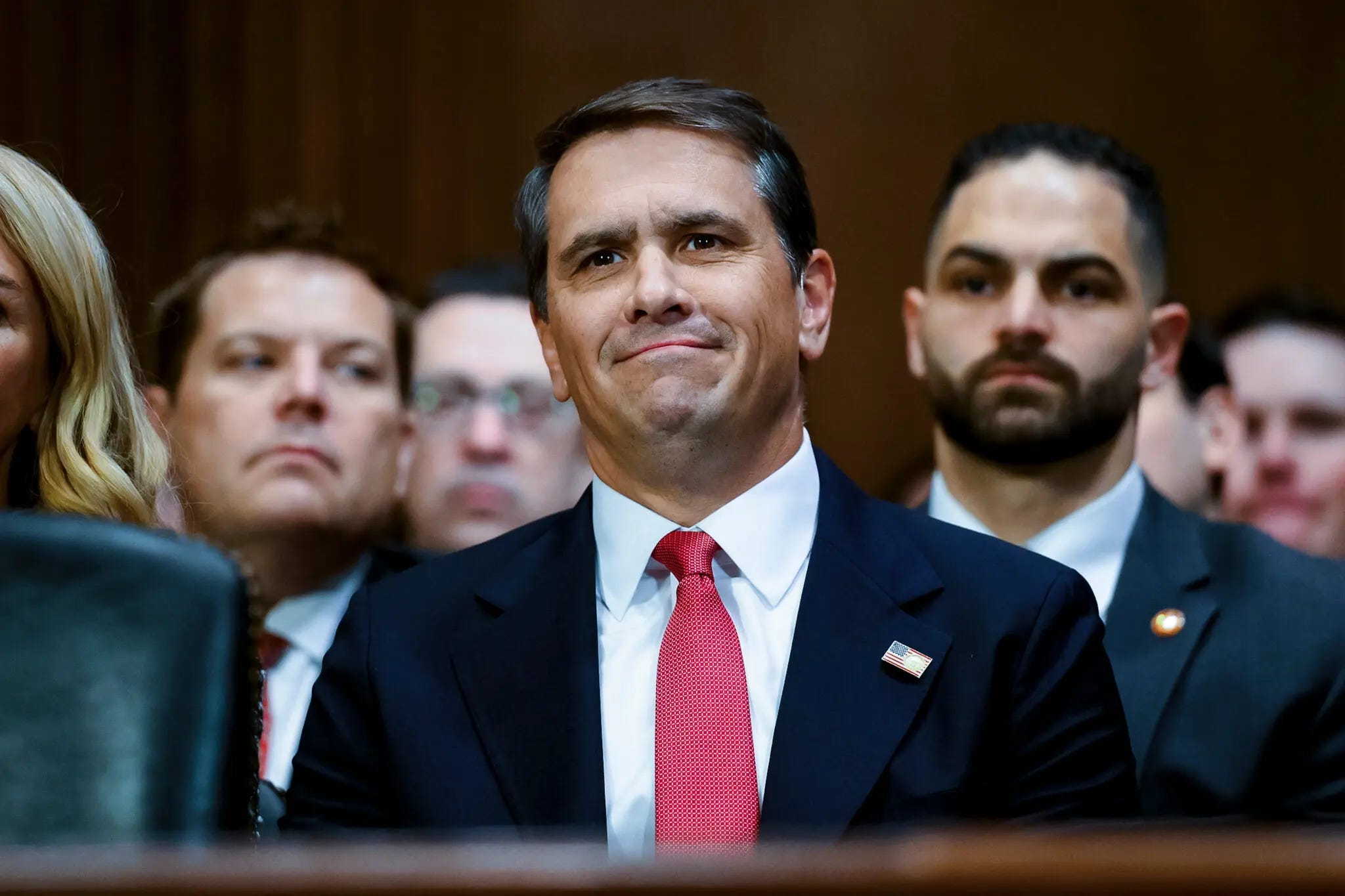
The President’s Lawyer Is Now America’s Attorney General
Trump’s former defense lawyer now leads the Justice Department—and the danger to its independence could not be clearer.
By Dr. John Petrone
There are moments when the danger to democratic government does not arrive with sirens, troops in the streets, or a declaration suspending the Constitution.
Sometimes it happens at 4:17 in the morning with a roll-call vote in the United States Senate.
On August 8, the Senate confirmed Todd Blanche as attorney general of the United States by the narrowest of margins: 50–49. Blanche is not merely another conservative lawyer chosen by Donald Trump. He is Trump’s former personal criminal defense attorney, a man who represented him before joining the Justice Department and who has since become one of the most powerful law-enforcement officials in the country.
Two Republican senators — Susan Collins of Maine and Lisa Murkowski of Alaska — joined every Democrat voting against the nomination. Their objections went directly to the heart of the matter: whether the Justice Department can remain sufficiently independent from a president who has repeatedly demanded personal loyalty from the people surrounding him.
That should trouble every American, regardless of party.
Because the attorney general does not work for Donald Trump.
The attorney general works for the United States of America.
And when that distinction begins disappearing, something far more important than one Cabinet appointment is at stake.
The Pattern
Todd Blanche did not arrive at the Department of Justice as some distant legal scholar or neutral Washington technocrat.
He represented Donald Trump in three criminal cases before Trump returned to office. The Justice Department itself acknowledges that history in Blanche’s official biography.
That fact alone does not make Blanche unqualified.
But it makes independence essential.
Instead, the controversy surrounding his confirmation raised precisely the opposite concern.
Blanche played a central role in negotiations surrounding Trump’s lawsuit against the federal government over the handling of his tax records. The resulting arrangement included plans for a roughly $1.8 billion fund intended to compensate people claiming they were victims of government “weaponization.” Reuters reported that, when questioned by lawmakers in May, Blanche would not rule out payments going to people who had assaulted police officers during January 6 or to Trump campaign donors.
Think about that for a moment.
Nearly two billion dollars in federal money.
Potential beneficiaries selected under a program created after a lawsuit brought by the sitting president.
And the possibility that some of those beneficiaries could include people prosecuted after attacking the United States Capitol.
That proposal became so politically radioactive that Republican senators themselves rebelled.
Then there was another extraordinary feature of the settlement: protections involving IRS scrutiny of Trump, members of his family, and his businesses. Collins specifically objected to protections she said were unavailable to ordinary American taxpayers.
Eventually Blanche gave senators written assurances that the fund would not move forward and that the tax protections would be narrowed.
And apparently, for enough senators, that was good enough.
It should not be.
Because the disturbing question is not simply whether the fund ultimately survives.
The disturbing question is:
How did something like this get this far in the first place?
Why This Matters
Imagine reversing the political parties.
Imagine a Democratic president installing his former criminal defense attorney as attorney general.
Imagine that attorney general participating in negotiations producing special federal tax protections involving the president’s family.
Imagine a nearly $2 billion government fund that might compensate political allies claiming they had been unfairly prosecuted.
Imagine Democratic senators shrugging their shoulders and saying, essentially, Well, he promised us he won’t do it again.
Republicans would be calling congressional hearings before breakfast.
Fox News would run the story around the clock.
Conservative commentators would call it corruption.
And they would have every right to demand answers.
Because the rule of law cannot depend upon which political party controls the White House.
That is the entire point.
The attorney general possesses breathtaking authority. The Justice Department can investigate. It can subpoena. It can prosecute. It can imprison.
Those powers cannot become extensions of presidential grievance.
They cannot be used to reward friends.
They cannot be used to punish enemies.
And they certainly cannot operate under a system where Americans must wonder whether the president’s former personal attorney still sees his principal responsibility as protecting the president who once employed him.
That is precisely why independence matters.
The Constitutional Stakes
Our Constitution does not explicitly declare the Department of Justice independent of presidential control.
Its independence instead developed through laws, traditions, ethical rules, institutional safeguards, congressional oversight, prosecutorial norms, and the accumulated lessons of American history.
Those norms exist for a reason.
Watergate taught America what happens when presidents attempt to transform federal law enforcement into a personal political instrument.
The lesson was supposed to be simple:
The president is not the client of the Department of Justice.
The American people are.
Yet Blanche’s confirmation arrives after months of controversy over precisely that boundary. The New York Times reported that concerns over departmental independence became central to his confirmation battle, while AP, Reuters, and The Washington Post similarly described Republican as well as Democratic unease about whether Blanche would resist presidential demands.
Senator Murkowski identified the problem clearly: America needs an attorney general capable of checking an administration’s worst impulses, and she was not convinced Blanche would do so.
That is not some radical proposition.
That is constitutional government.
America deliberately created institutions containing competing centers of power because the founders understood something about human nature that remains true today:
Power rarely restrains itself.
Congress was supposed to provide part of that restraint.
Yet once again, most Republican senators faced serious questions about an administration action, extracted promises from Trump’s nominee, and then ultimately supplied the votes Trump needed.
Senator Bill Cassidy openly acknowledged Blanche’s involvement in the fund and tax protections reflected poor judgment, according to the Times. But Cassidy ultimately concluded Blanche might be better positioned to resist Trump after receiving Senate confirmation than if Trump simply left him in office indefinitely as acting attorney general.
Consider what that reasoning tells us about where we are.
A United States senator effectively had to calculate whether confirming a nominee he distrusted might be safer than allowing the president to circumvent Senate resistance by keeping the same man in office without confirmation.
That is not reassuring.
It is alarming.
How We Fight Back
The answer is not partisan retaliation.
It is institutional accountability.
Congress must conduct aggressive oversight of the Justice Department regardless of which party controls the White House.
Commitments Blanche made during the confirmation process should be documented and monitored. If the $1.8 billion fund returns in another form, Congress should investigate it. If extraordinary tax protections involving the president or his family are expanded, Congress should investigate them. If federal prosecutions appear designed primarily to satisfy presidential political demands, Congress should demand testimony, documents, and explanations.
Inspectors general must be allowed to do their jobs.
Career prosecutors must be protected from improper political pressure.
Federal courts must continue scrutinizing executive actions against constitutional and statutory limits.
Journalists must keep digging.
Whistleblowers must be protected.
And citizens should demand the same ethical standard from officials they support that they demand from officials they oppose.
Because constitutional government collapses when misconduct becomes acceptable merely because our side is committing it.
The standard must remain the same.
No president should have a personal Justice Department.
No president should receive legal privileges unavailable to ordinary citizens.
No president should be able to turn the enormous investigative and prosecutorial machinery of the federal government into an instrument of personal revenge or political reward.
Republican president.
Democratic president.
Independent president.
It does not matter.
The rule of law either applies equally or it is not the rule of law.
The Bottom Line
Todd Blanche is now the attorney general of the United States.
The Senate has spoken.
But confirmation does not erase the questions surrounding how he arrived there.
It does not erase the nearly $1.8 billion fund.
It does not erase the controversy surrounding special tax protections involving Donald Trump and members of his family.
It does not erase Blanche’s history as Trump’s personal criminal defense attorney.
And it certainly does not erase the responsibility of Congress, the courts, the press, career Justice Department employees, and the American public to watch what happens next.
The most dangerous transformation of democratic institutions rarely occurs overnight.
It happens incrementally.
One exception becomes a precedent.
One conflict of interest becomes normal.
One abandoned safeguard becomes another.
One senator says, I don’t like it, but what is the alternative?
And eventually Americans look around and discover that institutions once designed to serve the country have slowly been reorganized around serving a person.
That is why this confirmation matters.
Not because Todd Blanche once represented Donald Trump.
Not because Republicans voted for him.
But because America is approaching a fundamental question about the presidency itself:
Does the Department of Justice serve the president — or does it serve the law?
There can be only one acceptable answer.
The Constitution does not belong to Donald Trump.
The Justice Department does not belong to Donald Trump.
The United States government does not belong to Donald Trump.
It belongs to us.
We the People.
And preserving that principle requires something democracy has always demanded from its citizens:
Attention.
Accountability.
Courage.
And an absolute refusal to normalize what should never become normal.
Defend the rule of law. Demand accountability. Never surrender the principle that no American — including the president — is above the law.


You are a person who will try to do for Trump while just using the courts to make Trump’s enemies go to jail. All the time, Trump is doing his corrupt business. If Blanche prosecuted him and give him a big fine. You are not my person. You are a joke.