

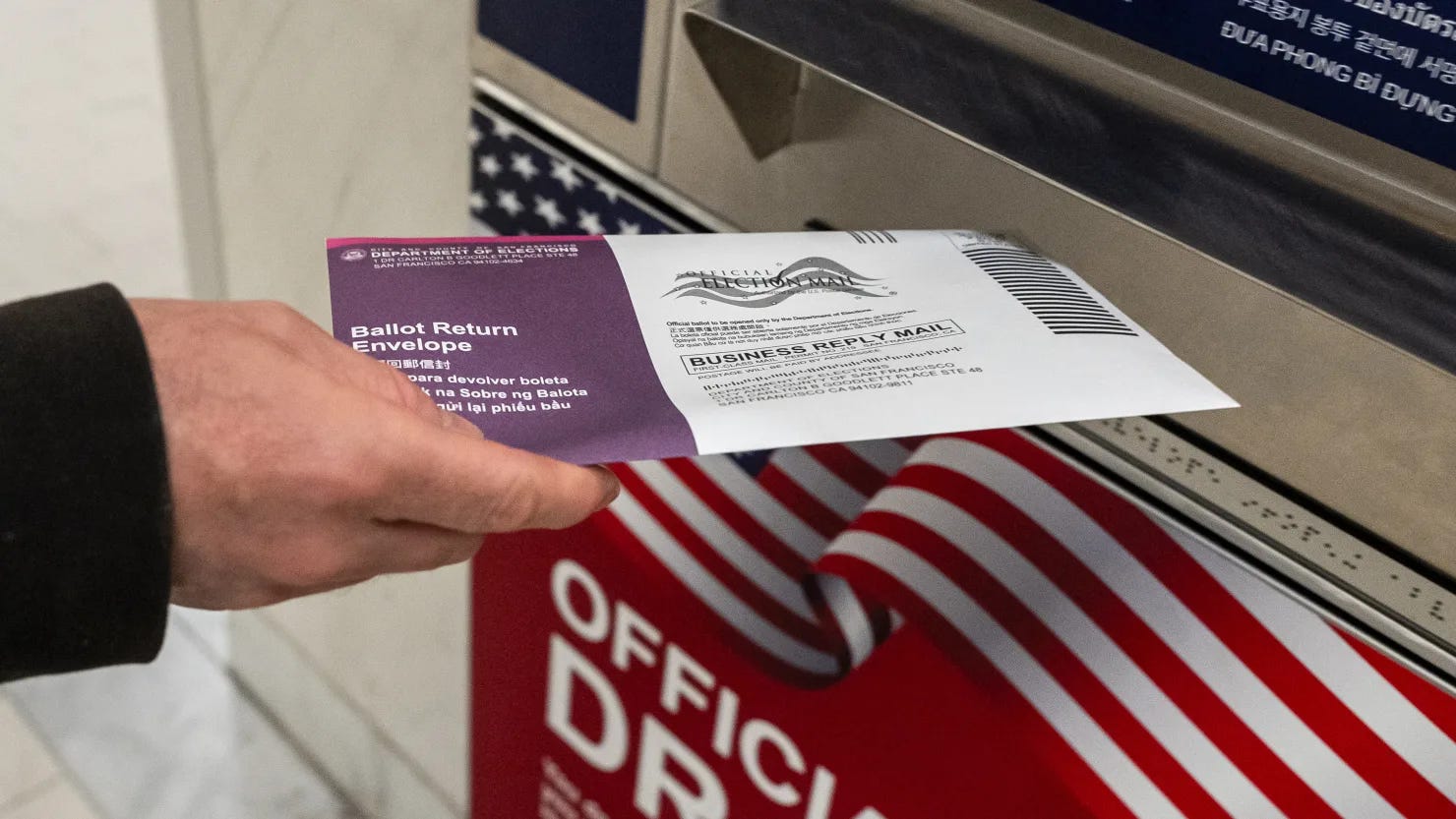
By Dr. John Petrone
There is one fact about Monday’s Supreme Court decision that Americans need to understand before anything else:
The Supreme Court did not rule that Donald Trump has the constitutional authority to rewrite the rules governing mail-in voting.
It did something potentially more consequential for the 2026 midterms.
The Court’s six-member conservative majority removed one of the legal barriers preventing the Trump administration from moving ahead with portions of its election executive order—even though the underlying constitutional fight remains unresolved.
Justice Ketanji Brown Jackson thinks that is a serious mistake.
In a blistering dissent, Jackson warned that the Court’s action “needlessly injects chaos and uncertainty into the upcoming midterm elections.”
She went further.
Jackson described the procedural maze confronting states as a “Kafkaesque nightmare.”
That might sound like overheated judicial rhetoric.
It isn’t.
Because once you understand what the Court actually decided—and how close we already are to ballots being mailed—Jackson’s warning becomes much harder to dismiss.
And the real danger is not simply whether you support or oppose mail voting.
It is something much bigger:
Who gets to make the rules of an American election—and how late can those rules change?
This Was Not a Victory on the Constitution
Donald Trump’s supporters will understandably describe Monday’s decision as a Supreme Court victory.
Procedurally, it was.
Constitutionally, however, the central question remains unanswered.
The Court did not decide that Trump’s executive order is lawful.
It did not decide that a president possesses broad authority to dictate how states administer mail ballots.
It did not reject the states’ constitutional arguments on their merits.
Instead, the majority concluded that the states challenging the executive order had not yet demonstrated the kind of concrete injury necessary to justify the particular injunction entered by the lower courts.
Translated out of legalese:
The states may have sued too soon.
And that is where this decision becomes so important.
Because election law has an unforgiving characteristic that most ordinary litigation does not:
There is a deadline.
November 3 is coming whether the courts are ready or not.
What Trump Is Trying to Change
Trump’s executive order directs federal agencies to become significantly more involved in election administration.
Among its provisions, the administration has sought greater federal involvement in verifying citizenship information and changing procedures involving mail ballots.
The U.S. Postal Service has also developed regulations connected to the administration’s effort.
And that matters because mail voting is no longer a peripheral feature of American elections.
Millions of Americans use it.
Military personnel use it.
Americans living overseas use it.
Elderly voters use it.
Disabled voters use it.
Working Americans who cannot easily reach polling places use it.
Entire states have developed election systems heavily dependent upon it.
So when Washington changes the rules governing ballot mail, election officials cannot simply flip a switch.
They have to change procedures, rewrite instructions, modify envelopes, update computer systems, train employees, educate voters, coordinate with postal officials—and do it all correctly.
Now Look at the Calendar
This may be the most important part of the story.
The November election is not some distant event awaiting us several months from now.
Election administration is already underway.
Ballot envelopes are being printed.
Military and overseas ballots will begin going out in some states within days.
Election officials are finalizing procedures that normally require months of preparation.
That means the legal question is no longer theoretical.
The Supreme Court has effectively told states that their earlier lawsuit may have been premature.
But if they wait too long to challenge the government’s actual implementation, another principle of election law can come into play:
Courts are traditionally reluctant to change election rules immediately before voting.
See the problem?
Sue too early: You may not have standing.
Sue too late: Courts may refuse to interfere with an election already underway.
That is the trap Jackson is describing.
And it ought to concern conservatives, liberals and everyone in between.
Justice Jackson Identified the Catch-22
Jackson’s dissent gets to the heart of what may become one of the most consequential election-law questions of 2026.
Federal courts require plaintiffs to demonstrate an actual or sufficiently imminent injury before they can sue.
That rule exists for good reason.
Courts should not issue advisory opinions about hypothetical disputes.
But elections operate differently from most government programs.
Imagine a state election official believes a new federal requirement is unconstitutional.
If she challenges it immediately, a court can say:
Nothing has happened yet.
If she waits until ballots have been redesigned and election procedures altered, a court can say:
Changing the rules now would create voter confusion.
Heads the government wins.
Tails the state loses.
That is the procedural nightmare Jackson is warning about.
And it becomes especially troubling when the dispute involves an election that will determine control of Congress.
There Is Another Constitutional Question Hiding Underneath All of This
Forget Trump for a moment.
Forget Democrats and Republicans.
Read the Constitution.
Article I, Section 4 provides that the “Times, Places and Manner” of congressional elections shall be prescribed in each state by its legislature, while giving Congress authority to alter those regulations.
Notice who is not expressly given that power.
The president.
That does not automatically mean every federal action affecting an election is unconstitutional.
Congress has given agencies—including the Postal Service—authority that can affect election administration.
The executive branch also has legitimate responsibility for enforcing federal law.
Those are the arguments the Trump administration will continue making.
But the underlying constitutional question is significant:
How far can a president go in directing federal agencies to alter election procedures that the Constitution primarily assigns to states and Congress?
Monday’s Supreme Court order did not answer that question.
Eventually, someone will have to.
And That Is Why Monday’s Decision May Actually Create More Litigation
Here is the irony.
The Supreme Court concluded that the states’ earlier challenge was premature.
But federal agencies are now moving further into implementation.
That makes the alleged injury increasingly concrete.
Which means states can return to court.
New plaintiffs can sue.
Different provisions can be challenged.
Postal regulations can face separate litigation.
District judges can issue new orders.
Appeals courts can review them.
And those cases can eventually arrive exactly where this one did:
Back at the Supreme Court.
Except next time the election will be even closer.
That is not stability.
That is a judicial countdown clock.
Why This Substack Page Matters
Most Americans will encounter this story as a headline:
SUPREME COURT SIDES WITH TRUMP ON MAIL BALLOTS.
Then the political machinery takes over.
One side celebrates.
The other side panics.
Everyone moves on to the next outrage.
But that headline does not tell you what actually happened.
The Court did not decide the constitutional question.
Another injunction remains.
Further litigation is almost certain.
Postal regulations matter.
Standing doctrine matters.
The election calendar matters.
And the distinction between winning a procedural ruling and winning the underlying constitutional case matters enormously.
That is what I want We the People United! to do differently.
Not simply tell you what happened.
Explain why it matters, what comes next, and what the headline leaves out.
If that kind of independent analysis is valuable to you, consider becoming a paid subscriber. Your subscription supports the research and writing necessary to go beyond the daily headlines and examine what these decisions actually mean for our democracy.
The Conservative Majority Does Have a Legal Argument
There is an argument for what the majority did, and it should not be ignored simply because one dislikes the outcome.
Federal courts are courts of actual cases and controversies.
They are not supposed to intervene every time a president issues an executive order that might eventually injure somebody.
If federal agencies have not yet completed their actions, courts ordinarily hesitate to decide disputes based upon speculation about what those agencies might ultimately do.
That is a legitimate judicial principle.
The difficulty is applying that principle to elections.
Because if courts insist upon waiting until injury becomes indisputable, election administrators may have very little time left to fix it.
That is the tension at the center of this case.
And Jackson believes the majority has placed too much of that risk on the states.
The Next Lawsuit May Be More Important Than This One
Watch what happens next.
The most important legal development may not be Monday’s Supreme Court ruling at all.
It may be the next challenge.
If federal agencies begin enforcing finalized requirements, states will have a much stronger argument that their injuries are no longer speculative.
That could move litigation away from procedural questions such as standing and toward the issue Americans really need answered:
Does the president actually have the authority to do this?
When that question finally reaches the Supreme Court, the stakes will be considerably higher.
Because then the justices may have to choose between two competing understandings of presidential power.
One gives the executive branch substantial latitude to use existing federal agencies and statutes to protect what it considers election integrity.
The other warns that allowing presidents to use executive authority to reshape election administration intrudes upon powers the Constitution deliberately gave elsewhere.
That decision could influence American elections long after Donald Trump is gone.
There Is a Democratic Principle Here That Should Not Be Partisan
Election rules should be known before elections.
That should not be controversial.
Republican voters deserve that certainty.
Democratic voters deserve it.
Independent voters deserve it.
Election workers deserve it.
Candidates deserve it.
And losing candidates should not be able to point to constantly changing rules as evidence that the system itself cannot be trusted.
One of the worst things government can do before an election is create ambiguity about how ballots will be cast, transmitted or counted.
Because distrust thrives in ambiguity.
And America already has more than enough distrust surrounding elections.
The Question Nobody Should Ignore
Imagine reversing the political parties.
Imagine a Democratic president issuing an executive order directing federal agencies to impose substantial new requirements affecting state election procedures shortly before congressional elections.
Would conservatives simply shrug and say presidential authority should be given the benefit of the doubt?
I doubt it.
And they shouldn’t.
Constitutional principles matter most when we apply them to presidents we support.
That is the test.
The question therefore should not be:
Do I trust Donald Trump?
Or:
Do I trust Democratic governors?
The question should be:
What power does the Constitution actually give a president over federal elections?
That answer should remain the same regardless of which party occupies the White House.
The Bottom Line
Justice Jackson’s dissent is attracting attention because of three memorable words:
Chaos. Uncertainty. Kafkaesque.
But strip away the rhetoric and her argument is straightforward.
The Supreme Court has allowed part of Trump’s election initiative to move forward without deciding whether the president ultimately possesses the authority to impose it.
States may challenge the policy again.
Federal regulations may be challenged separately.
Another injunction remains.
More litigation is coming.
And all of this is happening while election officials are preparing ballots and voters are preparing to cast them.
That is the part Americans should focus on.
Not whether Trump “won” Monday.
Not whether Jackson wrote an unusually sharp dissent.
Not which political team can turn the ruling into the best fundraising email.
The important question is whether the United States is approaching a congressional election without knowing precisely which election rules will survive judicial review.
Because democracies depend upon something extraordinarily basic:
Everybody needs to know the rules before the game begins.
And in the 2026 midterms, the game has already begun.
We the People deserve constitutional clarity before Americans start casting ballots—not after the votes have already been counted.
If You Found This Useful
Most political news tells you what happened.
We the People United! is about understanding what it means.
If you want independent analysis of the 2026 elections, the courts, the Trump administration, and the larger fight over American democracy—without reducing every issue to a cable-news shouting match—become a paid subscriber today.
Your subscription directly supports the research and writing that make deeper dives like this possible.
Already subscribed? Forward this post to someone who wants more than a headline.
P.S. Release All of the Epstein Files Now!
Is it possible that these six (in)justices are in fear for their own consequences for their obvious and large part in assisting the traitors and criminals of trump's cult, and are joining in trump's attempt to subvert the mid term election?
So a pretext of confusion is emerging which could lead to attempts in states by maga-istas to postpone with the key objective to stop theses elections ever taking place during Trump's current term as he tees up term 3?