

By Dr. John Petrone
Donald Trump signed an executive order Thursday directing the federal government to rename Lake Ontario “Lake America.”
It does not give the United States control over the lake. It does not require Canada, New York, international organizations, mapmakers, journalists, schools, or ordinary Americans to use Trump’s preferred name.
What it does reveal is a president willing to use the machinery of government to manufacture spectacle, provoke an ally, erase an Indigenous name, and transform his personal grievances into official federal policy.
This is not simply a silly argument over a map. It is another example of Trump trying to make reality answer to him.
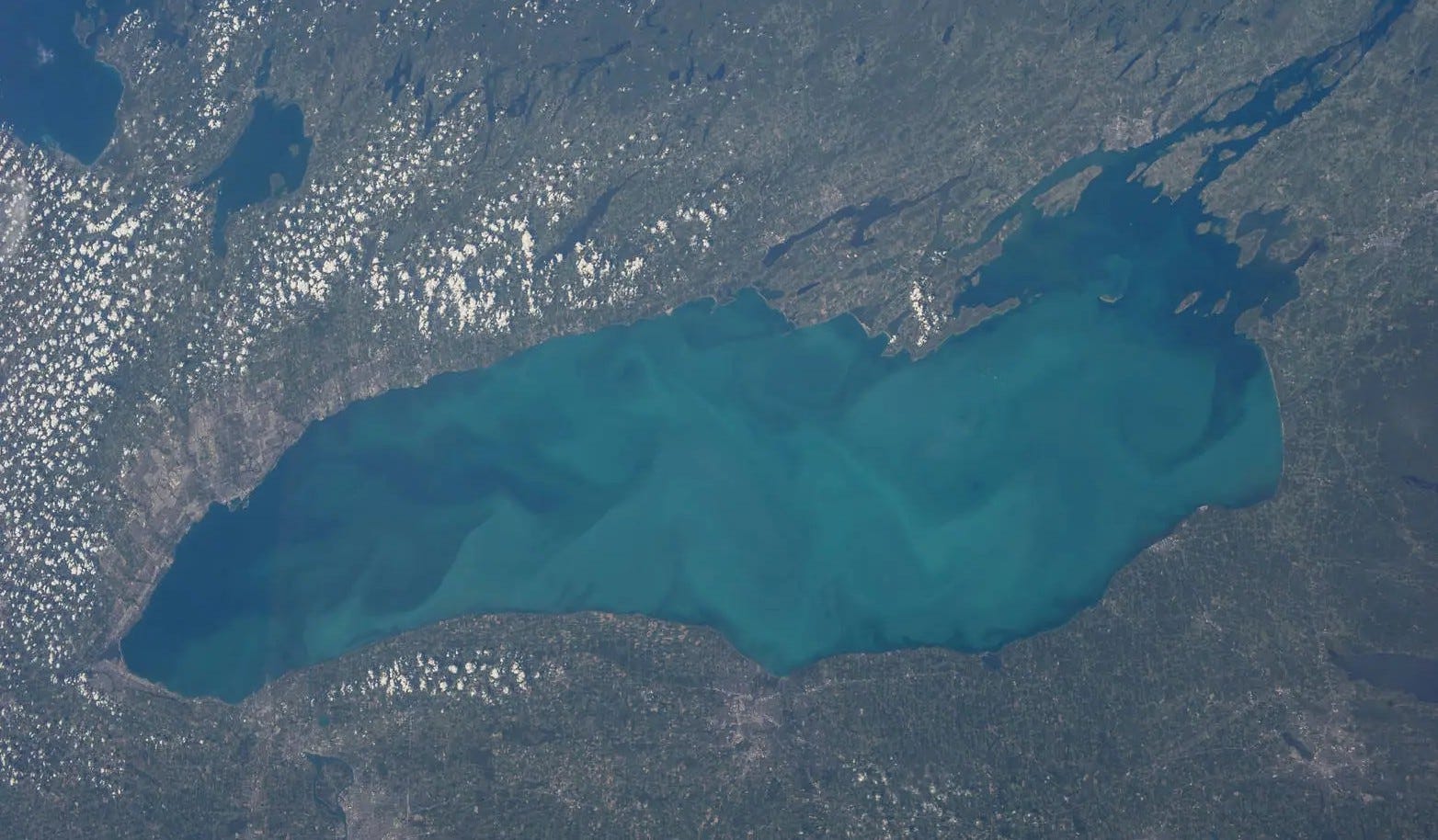
Lake Ontario photographed from the International Space Station. The international boundary runs through the lake, which is shared by the United States and Canada. Credit: NASA/ISS Expedition 36, public domain.
What Trump Actually Did
The executive order directs the secretary of the interior and the U.S. Board on Geographic Names to replace “Lake Ontario” with “Lake America” in the federal Geographic Names Information System.
Federal agencies would then be expected to use the new designation on government maps, contracts, documents, and official communications.
Trump called the change “effective immediately,” but the order itself gives the Interior Department 30 days to carry it out.
That distinction matters.
Trump did not acquire territory. He did not redraw the international boundary. He did not obtain Canada’s consent. He did not rename the lake for the world.
He ordered his own executive branch to use a different label.
That is the actual reach of this executive order—and no amount of Oval Office theater can make it larger.
The Limit: What Trump Cannot Do
Lake Ontario is an international body of water shared by the United States and Canada. Approximately 52 percent of its surface area lies on the Canadian side of the border, with the remainder adjoining New York.
Trump has broad authority to determine what federal agencies call geographic features. The U.S. Board on Geographic Names exists to standardize federal terminology, and its decisions are binding within the federal government.
But federal terminology is not international law.
Trump cannot order Canada to adopt the name. He cannot compel New York State to use it. He cannot force foreign governments, international organizations, private publishers, universities, news agencies, or the public to participate.
There is no single international authority with the power to impose one name on every country. Shared geographic features frequently carry different names in different nations.
In this case, however, Canada is not proposing a new name. Trump is attempting to replace a name that has endured for centuries.
Canadian Prime Minister Mark Carney responded that the lake will remain Lake Ontario “then, now and always.”
Ontario Premier Doug Ford said it would remain Lake Ontario to Canadians and the rest of the world.
New York Governor Kathy Hochul was even more direct: “New York won’t be calling it that.”
Trump may control the words appearing on federal maps. He does not control history, geography, or the English language.
The History He Is Trying to Erase
The name Ontario did not originate with the Canadian government.
It predates both the Canadian Confederation of 1867 and the American Declaration of Independence of 1776.
“Ontario” derives from the Wendat word Ontari’io. It has been translated as “the lake is beautiful, the lake is big,” “great lake,” or “lake of shining waters.”
European mapmakers were using Ontario as the lake’s name during the 17th century. The name appeared on maps of North America as early as the 1650s.
The lake did not take its name from the province. The province eventually took its name from the lake.
That history makes Trump’s action especially offensive.
Grand Chief Pierre Picard of the Wendat Nation condemned the order as an attempt to erase Wendat history. He was right to do so.
The White House described the change as honoring American heritage, yet the order replaces an Indigenous name with a slogan created to satisfy Donald Trump’s political branding.
That is not historical restoration.
It is historical appropriation.
The White House’s Case Does Not Establish Ownership
The executive order attempts to justify the change by emphasizing American investments, shipping interests, military history, and icebreaking operations on the Great Lakes.
It notes that the U.S. Coast Guard operates nine of the 11 icebreaking vessels serving the Great Lakes. It cites billions of dollars in American environmental investments. It also argues that because the deepest portion of Lake Ontario lies on the American side, the United States can claim most of the lake’s water volume.
Those facts do not produce the conclusion Trump wants.
Operating more icebreakers does not confer naming rights. Funding environmental restoration does not transfer sovereignty. Water depth does not move an international boundary.
The order’s financial comparison is also incomplete. It cites nearly $4 billion in U.S. Great Lakes restoration spending but does not provide a transparent, equivalent accounting of Canadian federal, provincial, municipal, infrastructure, environmental, and Coast Guard investments.
Cooperation between the two countries has never depended on each side spending precisely the same amount through identically structured programs.
The Great Lakes are protected and managed through more than a century of binational cooperation, including the 1909 Boundary Waters Treaty and the International Joint Commission.
That cooperative history—not Trump’s invented naming contest—is what has kept commerce moving, drinking water available, environmental restoration underway, and disputes from becoming international crises.
The Pattern
The important question is not whether “Lake America” sounds ridiculous.
It does.
The important question is why the president of the United States is devoting federal authority to a deliberately provocative stunt during a rapidly escalating trade conflict with America’s closest neighbor.
The answer is that Trump governs through domination, humiliation, and spectacle.
Since returning to office, he has repeatedly taunted Canada about becoming America’s 51st state. He has treated tariffs not simply as economic policy but as instruments of personal punishment. He has portrayed alliances as protection rackets in which other nations must demonstrate loyalty to him.
Now he is attempting to write that posture onto the map.
Trump used the same nationalist branding when he ordered the federal government to call the Gulf of Mexico the “Gulf of America.” He has attached his name or political identity to government buildings, programs, proposed warships, prescription-drug initiatives, investment accounts, and other symbols of public power.
During Thursday’s ceremony, he even suggested that the Atlantic or Pacific Ocean might be next.
That comment may sound like another offhand Trump boast. It should still be understood as part of the pattern.
Every absurdity creates a new loyalty test.
Will federal agencies obey?
Will media organizations repeat the new name?
Will elected Republicans pretend it is normal?
Will the public laugh, become exhausted, and move on before asking why taxpayer-funded institutions are being used to validate one man’s ego?
The spectacle is the mechanism.
Why This Matters
The United States and Canada are engaged in a serious trade conflict.
The Trump administration recently imposed 50 percent tariffs on approximately $20 billion in Canadian goods after negotiations collapsed. Canada responded with retaliatory tariffs on approximately $20 billion in American products, including steel, dairy products, appliances, and agricultural equipment.
Those tariffs have consequences for workers, farmers, manufacturers, businesses, and consumers on both sides of the border.
Instead of lowering tensions and negotiating responsibly, Trump turned a shared lake into another weapon of political humiliation.
That damages more than Canada’s feelings.
The United States and Canada cooperate on defense, intelligence, energy, trade, border security, environmental protection, transportation, shipping, and the management of shared waterways. The Great Lakes themselves are sustained through institutions built upon consultation and mutual responsibility.
Those relationships cannot be maintained indefinitely if one country’s president treats the other as an enemy to be mocked, economically punished, absorbed, or symbolically erased.
Seventy-two percent of Americans expressed a favorable view of Canada in a May Reuters/Ipsos poll.
Trump is manufacturing hostility toward a country the American people overwhelmingly regard as a friend.
The Constitutional Stakes
The most responsible criticism is also the most precise one.
This executive order is not automatically unconstitutional merely because it is arrogant, historically insulting, or diplomatically reckless. Presidents have considerable latitude over terminology used by executive-branch agencies.
The constitutional concern lies in the larger accumulation of power and behavior.
Trump repeatedly treats executive authority as an extension of his personal identity. Government agencies become instruments for rewarding loyalty, punishing opposition, controlling public language, rewriting history, and turning presidential preferences into official reality.
That is how democratic government becomes personalized.
The danger is not that Americans will suddenly forget the name Lake Ontario. The danger is that we become accustomed to a president using public institutions to satisfy private resentments—and that each new abuse seems less alarming because the previous one was allowed to stand.
As an Air Force veteran and an educator, I do not confuse loudness with strength.
Real national strength requires discipline, historical understanding, credible alliances, and respect for the limits of power. Picking a fight with Canada over the name of a shared lake demonstrates none of those qualities.
It is not patriotism.
It is insecurity wrapped in a flag.
How We Fight Back
First, call the lake by its name: Lake Ontario.
Second, explain accurately what the order does and does not accomplish. Do not exaggerate Trump’s authority by pretending he has renamed the lake for Canada or the world.
Third, refuse to let the comedy obscure the consequences. The same administration staging a map stunt is escalating a trade war that can raise prices, disrupt supply chains, damage American agriculture, and threaten manufacturing jobs.
Fourth, defend the Indigenous history Trump’s order attempts to push aside. The name Ontario is not foreign to America. It comes from a North American people whose history long predates the United States.
Fifth, demand that Congress conduct oversight of the money, staff time, map revisions, database changes, contract updates, signage, and administrative work required to carry out politically motivated renaming campaigns.
Finally, remember that ridicule alone is not resistance. Authoritarian politics often arrives surrounded by absurdity because absurdity leaves the public uncertain about whether to laugh or sound the alarm.
We can do both.
We can recognize that “Lake America” is ridiculous while also recognizing what it represents.
The Line We Draw
Donald Trump can order federal employees to type “Lake America” into a government database.
He cannot make Canada surrender its history.
He cannot move the international border.
He cannot erase the Wendat origin of the name.
He cannot force New York to cooperate.
He cannot transform political theater into geographic truth.
And he cannot make the rest of us surrender our obligation to call things what they are.
It was Lake Ontario before Donald Trump entered politics.
It is Lake Ontario today.
It will remain Lake Ontario long after his executive order is remembered as one more embarrassing artifact of an administration that mistook presidential power for personal ownership.
That is the line we draw: no president owns our institutions, our history, our alliances, our language—or reality itself.
If this analysis helped cut through the spectacle, please restack it so more readers can understand what Trump’s order actually does, what it cannot do, and why the distinction matters.
Thank you!
What a jerk! LakeOntario will remain as it is forever! Bless you Canada, we love you! Fight for what is right