

By Dr. John Petrone
President Donald Trump has discovered something about American government that may prove more consequential than any single executive order, court case, or building project.
The presidency can move very quickly.
The courts usually cannot.
That difference has always existed. What is different now is the degree to which the Trump administration appears willing to exploit it.
Adam Liptak’s reporting in The New York Times today centers on the new White House ballroom, but the larger issue goes well beyond construction at 1600 Pennsylvania Avenue.
Across federal employment, immigration, spending, elections, and administrative agencies, the same question keeps appearing:
What happens when a president can substantially complete an action before the courts determine whether he was legally permitted to take it?
That is no longer an academic question.
It is becoming one of the defining separation-of-powers questions of Trump’s second presidency.
What Happened
The White House ballroom controversy may be the clearest example yet.
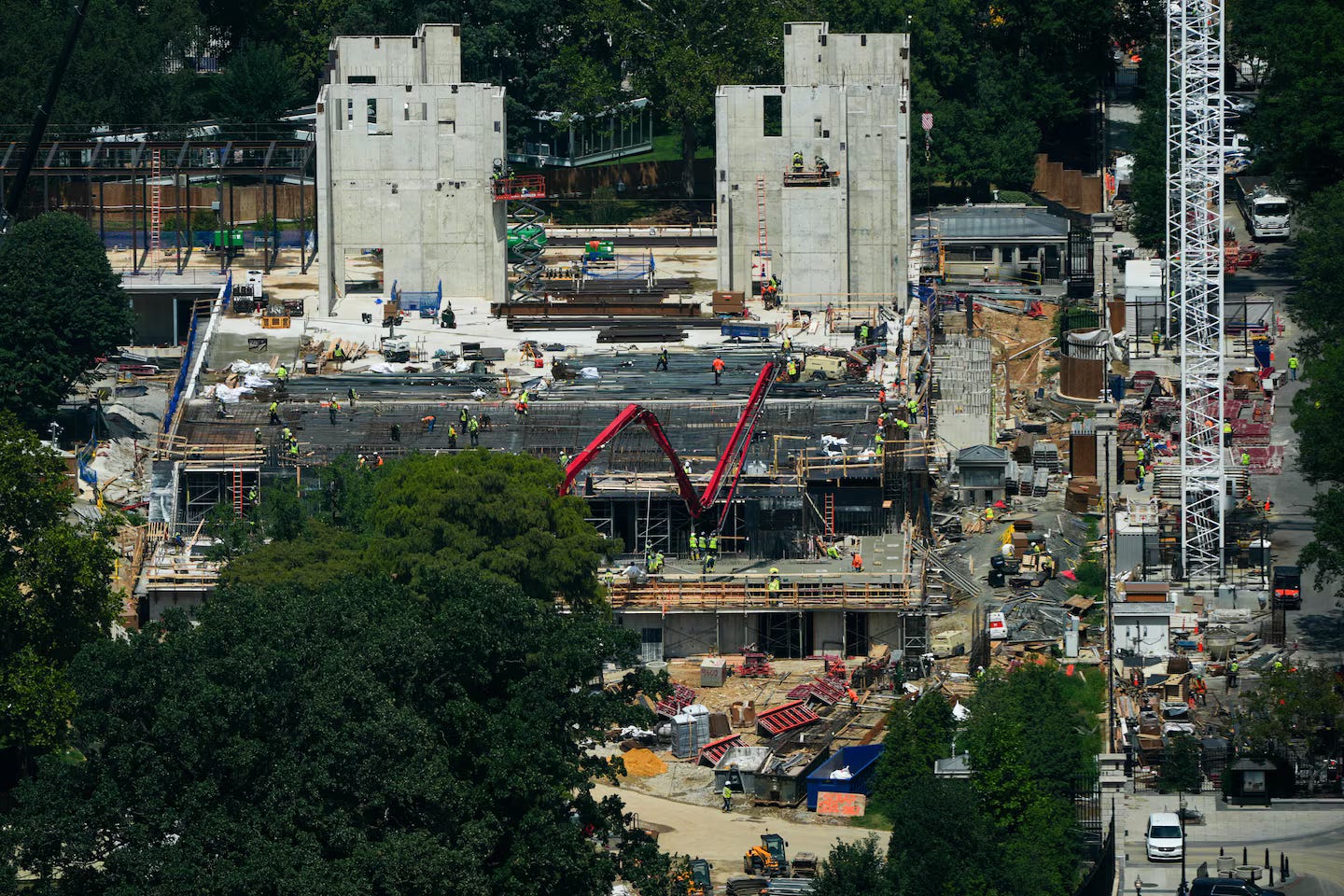
Trump ordered the demolition of the East Wing to make way for a privately funded ballroom complex. The project has been reported at roughly $400 million and about 90,000 square feet. Construction began while legal challenges were still moving through the federal courts.
The National Trust for Historic Preservation sued, arguing that federal law requires express congressional authorization before a building or structure can be erected on federal public grounds in Washington.
Lower courts largely agreed that the challengers were likely to prevail.
Then the case reached the Supreme Court.
On Monday, the Court allowed construction to continue by a 5-4 vote.
But here is the part that matters most:
The Supreme Court did not rule that the ballroom is legal.
The majority instead concluded that the National Trust had probably failed to establish the kind of direct injury necessary for Article III standing.
Chief Justice John Roberts joined Justices Sonia Sotomayor, Elena Kagan, and Ketanji Brown Jackson in dissent.
Roberts wrote that the construction was “likely unlawful.” He pointed directly to the federal statute prohibiting construction on federal grounds in Washington without express congressional authorization.
Yet construction continues.
That is the constitutional problem in miniature.
A federal court can believe an executive action is probably unlawful and still be unable to stop it because the dispute becomes entangled in standing, jurisdiction, emergency stays, and procedural rules.
Meanwhile, bulldozers do not wait for appellate briefing.
Liptak highlights an extraordinary exchange from the ballroom litigation.
During argument before the D.C. Circuit, Judge Patricia Millett asked the Justice Department what would happen under its legal theory if the government moved rapidly to bulldoze the Statue of Liberty.
Could the courts stop it?
The government attorney’s answer, in substance, was no.
That hypothetical sounds absurd until you understand what Millett was testing.
She was not really asking about the Statue of Liberty.
She was asking whether an executive branch can make judicial review meaningless simply by acting faster than anyone can obtain an enforceable order.
The ballroom suggests the answer may sometimes be yes.
The Pattern
This is not just about one ballroom.
Justice Ketanji Brown Jackson identified the broader concern last week in a separate Supreme Court dispute involving election administration.
She described what she saw as a “Catch-Me-If-You-Can approach” to presidential policymaking.
The phrase is striking because it captures the dynamic almost perfectly.
Act first.
Force someone to sue.
Challenge that person’s standing.
Seek an emergency stay.
Continue implementing the policy.
Appeal.
And while courts decide whether the president had the authority in the first place, change the facts on the ground.
We have seen variations of that approach repeatedly.
Consider federal employment.
In July 2025, the Supreme Court allowed the administration to proceed with plans for large-scale federal workforce reductions while legal challenges continued. The decision opened the way for major cuts across numerous agencies. Reuters reported that about 260,000 federal workers had already left through dismissals, resignations, or retirements as the administration pursued its restructuring campaign.
That matters because even if a later lawsuit succeeds, rebuilding an institution is not as simple as reversing an order.
Experienced employees leave.
Institutional knowledge disappears.
Programs close.
Responsibilities are transferred.
Entire organizational cultures can change.
A judge can order reinstatement.
A judge cannot always reconstruct the government that existed six months earlier.
Federal spending presents the same problem.
In July, a federal judge ruled that the administration could not cancel already awarded grants merely because they no longer matched current White House priorities.
The states challenging the policy said more than $5 billion involving approximately 1,100 grants could be affected.
Last week, another federal judge blocked the administration’s effort to restructure federal funding for organizations that enforce fair-housing laws.
Again, timing matters.
A nonprofit that loses funding may lay off employees.
A research project may shut down.
A community program may disappear.
A university laboratory may lose researchers who move elsewhere.
If the money is restored a year later, the legal victory may be real while the practical damage remains.
Immigration shows the stakes even more dramatically.
Reuters reported earlier this year that federal judges had ruled more than 4,400 times that ICE had illegally detained people under one aspect of the administration’s detention policy.
At least 400 judges had issued rulings against the practice, yet the detention system continued to generate thousands of additional cases.
When someone’s liberty is involved, judicial delay has consequences that cannot be refunded.
Six months spent unnecessarily detained cannot be returned.
A person removed from the country cannot always be restored to the position they occupied before deportation.
That is where the difference between eventual judicial review and meaningful judicial review becomes critical.
Why It Matters
There is an important counterargument here, and it deserves to be taken seriously.
Federal courts are not supposed to act as general supervisors of the presidency.
The Constitution limits them to actual cases and controversies.
Plaintiffs need standing.
Judges need jurisdiction.
Courts are supposed to decide concrete disputes, not issue advisory opinions every time someone believes a president has exceeded his authority.
Those limits protect democracy too.
A judiciary that could intervene whenever a judge disliked an executive policy would create an entirely different separation-of-powers crisis.
That is why the ballroom decision cannot fairly be summarized as five justices declaring Trump’s conduct lawful.
They did not.
Their decision rested largely on whether this particular challenger had the legal right to bring the case.
That distinction is essential.
But it also exposes the danger.
Because an action does not become lawful simply because the wrong plaintiff sued.
And when government action becomes irreversible before anyone with unquestioned standing can obtain relief, constitutional limits risk becoming theoretical rather than practical.
Think about the possible sequence:
The building has already been constructed.
The employees have already been dismissed.
The agency has already been dismantled.
The funding recipient has already closed.
The immigrant has already been deported.
The election has already occurred.
At that point, a court may still issue a beautifully reasoned opinion.
But what exactly has been checked?
That is the deeper problem.
Our constitutional system assumes that the three branches possess meaningful tools to restrain one another.
Congress writes laws and controls appropriations.
The president executes those laws.
The judiciary determines whether governmental actions comply with the Constitution and statutes.
But that system depends upon more than formal authority.
It depends upon timing.
A brake applied after the vehicle has already gone over the cliff is still technically a brake.
It just is not very useful.
The Supreme Court’s increasingly consequential emergency docket makes this even more important.
Major national policies are now frequently reaching the justices through emergency applications before full trials, complete factual records, or ordinary appellate review.
The Court may therefore decide whether a policy continues temporarily without deciding whether the policy itself is ultimately lawful.
That temporary decision can become enormously consequential when the government moves quickly.
The ballroom case demonstrates it perfectly.
The Court has not determined that Trump possesses lawful authority to build it.
But the building may be substantially complete before anyone receives a definitive answer.
How We Fight Back
The answer cannot simply be to demand that judges abandon constitutional requirements whenever the executive branch moves quickly.
That would replace one dangerous precedent with another.
The answer is to make our existing system of checks and balances capable of functioning before disputed actions become irreversible.
Congress has a major role.
If lawmakers believe statutes are being circumvented through rapid executive implementation, they can write clearer laws.
They can establish explicit causes of action identifying who has standing to sue.
They can create expedited judicial-review procedures for certain categories of executive action.
They can use appropriations authority.
They can conduct oversight.
They can require reporting before major structural changes occur.
They can make unmistakably clear when executive agencies must obtain congressional approval before acting.
And ultimately, voters choose the members of Congress who decide whether that institution will exercise those powers.
The courts also need to confront the practical consequences of irreversibility when considering preliminary relief.
That does not mean plaintiffs automatically win.
It means judges should recognize that the injury being evaluated is sometimes not merely what the government is doing today.
The injury may be the destruction of the court’s ability to provide an effective remedy tomorrow.
There is also a responsibility that belongs to all of us.
We have to stop treating every constitutional dispute as nothing more than another Trump-versus-Democrats argument.
Presidential power does not disappear when a president we dislike leaves office.
It transfers to the next president.
Every power tolerated today becomes available tomorrow.
Republicans should therefore ask themselves whether they would be comfortable with a future Democratic president using identical tactics.
Democrats should ask the same question when their party controls the White House.
That is the test that matters.
Not whether we trust this president.
Whether we trust every future president with the authority being established now.
The Line We Draw
The issue before us is larger than Donald Trump’s ballroom.
The ballroom is simply the most visible monument to a much larger constitutional problem.
A president who learns that he can repeatedly act faster than courts can review his conduct does not need to openly defy judicial authority.
He can simply make judicial authority arrive too late.
That distinction should concern anyone who believes in limited government.
The rule of law does not require that courts win every dispute with the executive branch.
It does not require judges to stop every presidential initiative.
It does not require treating every aggressive use of executive power as unconstitutional.
But the rule of law does require something fundamental:
There must remain a meaningful opportunity to determine whether government action is lawful before that action becomes impossible to undo.
Otherwise, the question slowly changes.
Instead of asking, Does the president have the legal authority to do this?
We begin asking, Can anyone stop him before he finishes doing it?
Those are not the same question.
And a constitutional republic should never allow the second question to replace the first.
The White House ballroom will eventually be finished.
The far more important question is what else is being built along with it.
Because if the lasting precedent is that a president can outrun Congress, outrun litigants, and outrun the courts simply by moving fast enough, then Trump will have constructed something much larger than a ballroom.
He will have helped construct a presidency in which speed itself becomes a source of power.
And that is a precedent every American should think very carefully about before accepting.
If you believe these issues deserve more than a headline and a 30-second sound bite, please Restack and share this piece so more people can join the conversation.
P.S. Release the Epstein Files.
He can’t outrun impeachments.
We need to pack SCOTUS with justices who are left leaning and follow the Constitution. Period. Enough of this right-wing bullshit!