Trump Just Held America’s Homes Hostage to His War on Voting
He came to the Capitol demanding obedience, not governing. And when Congress would not bend the knee, he punished the American people instead.
By Dr. John Petrone
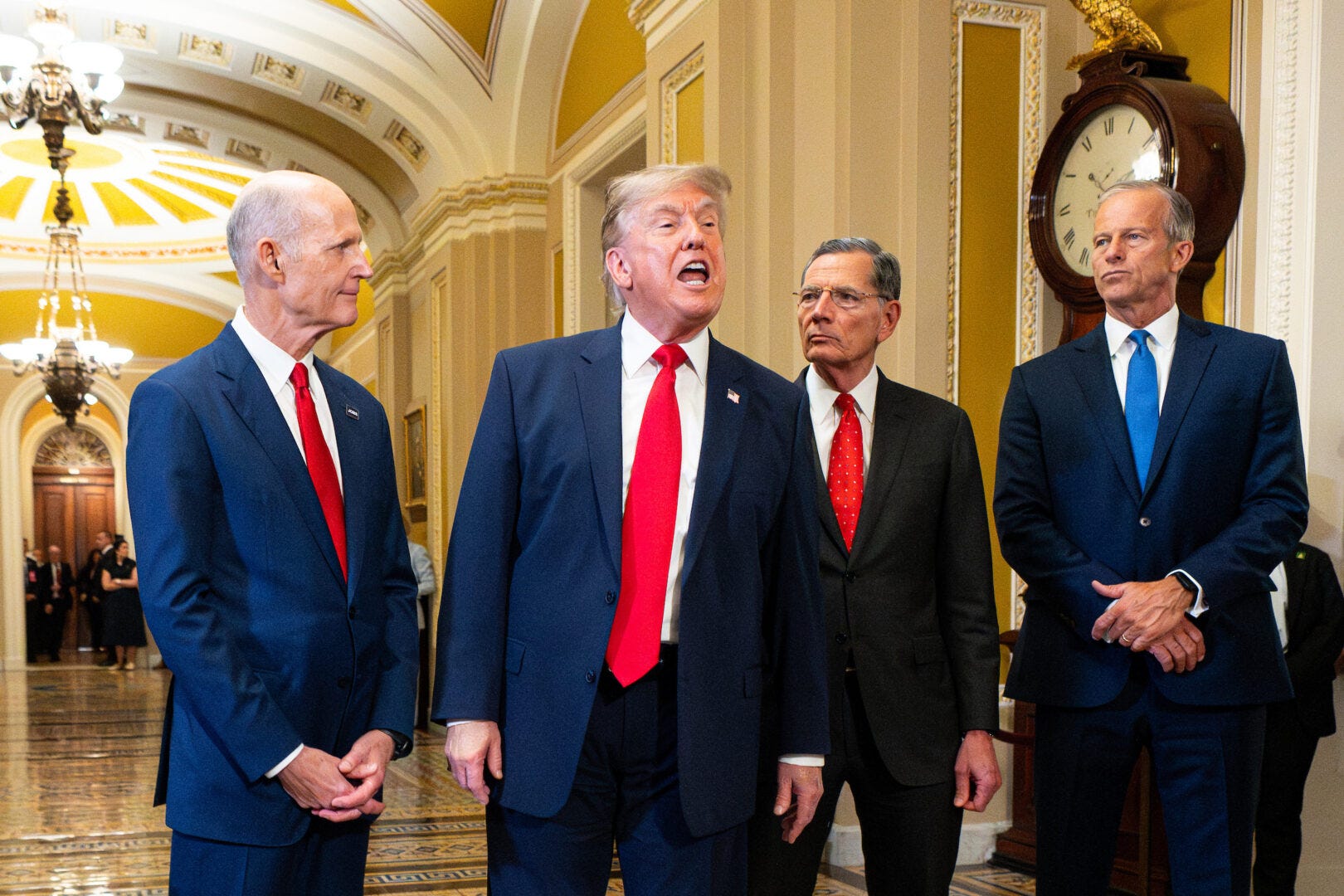
Donald Trump did not go to Capitol Hill on Wednesday to govern.
He went there to dominate.
He went there to demand that Republican senators fall in line behind a voting-rights crackdown they know does not have the votes. He went there to berate, threaten, insult, and pressure members of his own party. And when they did not immediately give him what he wanted, he did what authoritarians always do when confronted with limits on their power:
He punished everyone else.
Hours before a planned signing ceremony, Trump canceled a major bipartisan housing bill that had sailed through Congress with overwhelming support. A bill designed to speed home construction, increase housing supply, and stop Wall Street giants from swallowing up single-family homes that should belong to working families.
A bill his own White House had celebrated.
A bill Americans desperately need.
Trump threw it aside anyway.
Not because the bill failed.
Not because it was unpopular.
Not because it would not help families struggling with rent, mortgage rates, and the disappearing dream of homeownership.
He threw it aside because Congress would not immediately deliver his latest power grab over American elections.
That is the story.
And it is uglier than one canceled bill signing.
The Pattern
For Trump, nothing is ever about policy.
Not housing. Not inflation. Not war. Not Congress. Not the Constitution. Not the people he claims to represent.
Everything is about submission.
The housing bill was supposed to be a rare moment of governing in an era of dysfunction. Republicans and Democrats had managed to agree that America has a housing crisis and that families deserve more than empty slogans while investors buy up neighborhoods and prices climb out of reach.
Trump had an opportunity to sign a bill that could have helped families in red states, blue states, rural towns, suburbs, and cities.
Instead, he used it as leverage.
He essentially told Congress: Give me the voting restrictions I demand, or ordinary Americans can wait.
That is not leadership.
That is hostage-taking.
And it is revealing.
For all the campaign-stage talk about “working families,” the moment Trump had to choose between a real measure to help Americans find affordable homes and a chance to tighten his grip on the electorate, he chose power.
Every single time.
The Vote He Wants to Make Harder
The SAVE America Act is being sold as “election security.”
That is the marketing.
The reality is far more dangerous.
The legislation would impose new federal voting restrictions, including photo identification requirements, documentary proof of citizenship for voter registration, greater federal control over voter-roll information, and severe limits on voting by mail.
Trump and his allies want Americans to believe this is about protecting democracy.
But democracy is not protected by making it harder for citizens to vote.
Democracy is protected by making sure every eligible citizen can vote, every ballot is counted, and every election is run according to law.
The White House wants the public to focus on the phrase “proof of citizenship.” But the real question is simpler:
What happens to the citizen who does not have a passport?
What happens to the elderly voter whose birth certificate is missing or inaccurate?
What happens to the married woman whose documents no longer match?
What happens to the rural voter who cannot easily travel to government offices?
What happens to the military family, the disabled voter, the poor voter, the student, the caregiver, the working parent?
Trump’s answer is clear.
They become collateral damage in his obsession with control.
Congress Finally Shows a Pulse
The Senate Republican leadership knows the mathematics.
The bill does not have the votes.
Trump knows it too.
That is why he is demanding that Republicans destroy the filibuster, bypass the norms of the Senate, and turn Congress into another rubber stamp for whatever he posts online before breakfast.
But there is a deeper story unfolding inside the Capitol.
Trump’s relationship with Senate Republicans is fraying because some of them are beginning to understand what the rest of us have understood for years:
You cannot satisfy a man who treats every disagreement as betrayal.
You cannot build a governing agenda around someone who changes the rules whenever he loses.
You cannot preserve a constitutional system by handing its guardrails to a president who sees every guardrail as a personal insult.
This week, Republican senators joined Democrats to reassert Congress’s authority over the war in Iran. Trump answered with rage and personal attacks.
He did not respond with evidence.
He did not respond with constitutional arguments.
He did not respond with humility.
He responded like a man furious that anyone dared remind him that he is not a king.
That is the danger.
Not merely the tantrum.
The worldview beneath it.
The Real Emergency Is Trump’s Contempt for Democracy
Trump calls his voting bill a “national emergency.”
But there is no national emergency requiring the president to hold affordable housing hostage.
There is no national emergency requiring Congress to make it harder for legitimate citizens to vote.
There is no national emergency requiring the Senate to erase its own rules because one man cannot tolerate being told no.
There is, however, a real emergency in this country.
It is the normalization of presidential blackmail.
It is the use of federal power as a weapon against dissent.
It is the steady effort to turn institutions built for the American people into instruments of personal loyalty.
Trump does not want a Congress that legislates.
He wants a Congress that obeys.
He does not want voters who participate.
He wants voters who can be screened, restricted, intimidated, and made to jump through bureaucratic hoops before they are allowed to exercise the most basic right in a democracy.
He does not want checks and balances.
He wants permission.
How We Fight Back
We do not look away.
We do not let the daily chaos exhaust us into silence.
We do not allow Trump’s manufactured crises to distract us from the central truth: he is testing whether Americans will accept a country where rights become privileges and Congress becomes a stage prop.
Call your senators.
Tell them no to voter suppression disguised as “security.”
Tell them no to holding housing, veterans’ needs, national security, or any other piece of public policy hostage to Trump’s demands.
Tell them no to gutting the filibuster for a bill designed to make voting harder.
Tell them no to blank checks for war.
Tell them no to a presidency that treats constitutional limits as inconveniences.
Then organize.
Vote.
Volunteer.
Support local election officials.
Help people register.
Make sure every eligible voter in your family, neighborhood, school, workplace, union, veterans’ group, faith community, and social circle knows exactly what is at stake.
Because Trump’s strategy depends on one thing above all else:
That decent Americans will become too tired to fight.
We will not.
The Line We Draw
This is the line.
A president does not get to hold American families hostage because Congress refuses to rubber-stamp his voting restrictions.
A president does not get to turn affordable housing into a bargaining chip for his personal obsession with power.
A president does not get to demand obedience from Congress while waging war on the very democratic institutions that make America worth defending.
Donald Trump can create chaos.
He can demand loyalty.
He can bully his party.
He can cancel ceremonies, threaten lawmakers, and flood the country with grievance after grievance.
But he cannot erase the Constitution.
He cannot erase the truth.
And he cannot erase the millions of Americans who still believe that this country belongs to its people — not to one man’s ego, one party’s fear, or one movement’s authoritarian fantasy.
We see the pattern.
We know the stakes.
And we are not backing down.


That law will go into effect if he doesn’t sign it in ten days, excluding Sundays.