

By Dr. John Petrone
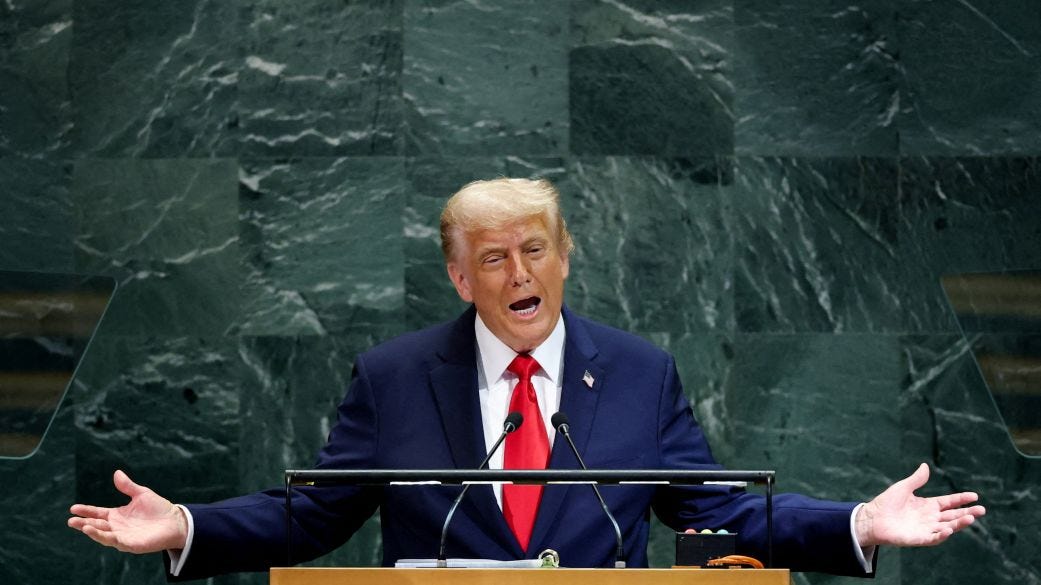
Donald Trump went before the United Nations General Assembly Tuesday and presented a straightforward argument about his foreign policy: while other leaders talk, he acts.
But buried inside the boasts, warnings and declarations were claims about Iran, Gaza, Venezuela, Greenland, drug trafficking, the International Criminal Court, artificial intelligence and conflicts around the world that deserve a closer look.
The Guardian’s Kenneth Roth offered one of the harshest assessments, calling Trump’s speech “delusional and dangerous” and arguing that it reflected a broader rejection of international law. That is Roth’s judgment. The underlying facts tell a more complicated story.
Some of Trump’s claims are supported by real diplomatic agreements.
Some are matters of interpretation.
Some remain deeply disputed.
And some have already been challenged by independent fact-checkers.
Here is what we actually know.
THE IRAN THREAT WAS NOT AN EXAGGERATION
The most striking words of Trump’s 37-minute address concerned Iran.
Trump said he faced a decision between reaching an agreement with Tehran and whether to “annihilate the Islamic Republic.”
Reuters reported the remarks exactly that way and noted that Trump simultaneously predicted a possible peace agreement after the November midterm elections.
That juxtaposition matters.
Trump was threatening potentially enormous military escalation while diplomacy was still taking place.
Hours later, he announced that American representatives had participated in what he described as a productive three-hour meeting involving Iran. Trump subsequently clarified that Steve Witkoff and Jared Kushner had met with mediators representing Iran rather than directly with Iranian officials.
So Tuesday produced two very different messages from the same administration:
Negotiate with us.
And:
The alternative could be catastrophic military escalation.
Whatever one thinks of that negotiating strategy, the threat itself was real and public.
It was delivered from the podium of an organization whose charter specifically requires members to settle international disputes peacefully and generally prohibits threats or uses of force against another state’s territorial integrity or political independence. The charter also recognizes circumstances such as self-defense and Security Council-authorized force.
That makes Trump’s language more than ordinary political rhetoric. It places the president’s approach to Iran directly inside an ongoing international debate over diplomacy, deterrence and the lawful use of military force.
THE NUCLEAR QUESTION IS MORE COMPLICATED THAN EITHER SIDE ADMITS
Trump again insisted that he would never allow Iran to obtain a nuclear weapon.
Iran has repeatedly denied that it intends to build one.
But that does not mean concerns over Iran’s nuclear program are imaginary.
The International Atomic Energy Agency reported this month that it still cannot verify the status of important Iranian nuclear facilities and material because inspectors have lacked the access necessary to conduct safeguards work. The agency described the situation as a serious proliferation concern.
At the same time, Trump’s description of the history leaves out an important fact.
The 2015 nuclear agreement negotiated during the Obama administration imposed restrictions on Iranian uranium enrichment and established an international inspection regime. Trump withdrew the United States from that agreement in 2018.
FactCheck.org has reported that Iran subsequently accelerated its enrichment program, significantly reducing the amount of time it would theoretically need to produce weapons-grade material if Tehran chose to do so. Developing enriched material, however, is not the same thing as possessing an operational nuclear weapon.
That history matters because neither slogan tells the whole story.
Iran’s nuclear activities present genuine proliferation concerns.
But the diplomatic agreement Trump abandoned had also placed meaningful restrictions on those activities.
GAZA: A CEASEFIRE IS NOT THE SAME THING AS COMPLETE PEACE
Trump told the General Assembly that his administration had “ended the war in Gaza” and pointed to his 20-point peace plan as one of his major diplomatic achievements. The transcript confirms those remarks.
There has been important progress.
A ceasefire was established. Hostage arrangements were carried out. A framework for Gaza’s future governance, security and reconstruction exists.
But implementation remains incomplete.
Reuters reported Wednesday that Trump’s Board of Peace is preparing a $2.45 billion six-month recovery initiative for Gaza. Yet Reuters also reported that the broader peace effort has stalled because Israel and Hamas have not fulfilled the conditions necessary to move important portions of the agreement forward.
Violence has also continued.
Reuters reported last week that more than 1,300 Palestinians had been killed in Gaza since the October 2025 ceasefire, according to Gaza health officials, while the Israeli military reported four Israeli soldiers killed. Israel and Hamas continue to accuse each other of violating the agreement.
Hamas disarmament, Israeli withdrawal and reconstruction remain unresolved.
So Trump can reasonably point to the ceasefire and diplomatic framework as achievements.
Calling the conflict fully resolved is harder to reconcile with conditions on the ground.
GREENLAND: THERE IS A DEAL, BUT GREENLAND WAS NOT TAKEN OVER
Trump also celebrated the new U.S. security arrangement involving Greenland.
That agreement is real.
The United States, Denmark and Greenland reached an agreement expanding America’s military access to the strategically important Arctic territory and restricting military bases or sensitive investments by non-NATO adversaries.
But there is an equally important distinction.
Greenland did not become American territory.
Reuters reported that the agreement falls well short of Trump’s earlier ambition to acquire Greenland. Denmark retains sovereignty, and Greenland remains an autonomous Danish territory.
The final agreement therefore represents something quite different from the territorial confrontation that dominated headlines earlier in Trump’s second term.
It is a security arrangement reached through negotiation.
That distinction deserves to be recognized.
THREE CLAIMS AP SAYS DO NOT MATCH THE AVAILABLE EVIDENCE
Some of Trump’s numerical claims were even easier to examine.
The Associated Press published a detailed fact check after the speech.
Trump said the United States has more military munitions than it could possibly use. AP reported that U.S. and NATO officials have warned about depleted stocks of some advanced missile interceptors and that rebuilding inventories could take years.
Trump said the United States and Venezuela together possess more than 60 percent of the world’s oil.
AP calculated that even using the largest available reserve estimates, the combined figure would be roughly 22 percent, not 60 percent.
Trump also claimed American strikes had eliminated 97 percent of drugs entering by sea.
AP and FactCheck.org both concluded that such a percentage cannot be established because there is no reliable way to calculate the amount of illegal drugs that enter the country without being detected.
Those are not disputes over ideology.
They are disputes over measurable claims.
THE INTERNATIONAL CRIMINAL COURT FIGHT IS GETTING BIGGER
Trump used his U.N. address to attack the International Criminal Court and urged countries belonging to the court to withdraw.
The United States itself has never joined the ICC.
But the administration may now go much further.
Reuters reported Sunday that the Trump administration has prepared sanctions against the ICC as an institution, not merely individual judges and prosecutors.
Court officials have warned that organization-wide sanctions could interfere with banking, information technology, insurance, investigations and even the payment of employees.
The Guardian’s Roth argues that targeting court officials for performing their duties could itself raise questions under the Rome Statute.
That is a legal argument, not a court ruling.
What is established is that the confrontation between Washington and the ICC is escalating and could materially affect the court’s operations.
DID TRUMP REALLY “SETTLE EIGHT WARS”?
Trump again said he had settled eight wars.
That claim needs context.
Reuters examined the president’s diplomatic record earlier this year and found a mixed picture. In several conflicts, Trump played a meaningful role in negotiating ceasefires or agreements. In others, fundamental disputes remained unresolved, fighting resumed or the agreements were never fully implemented.
The Democratic Republic of Congo is one example.
The United States helped broker agreements between Congo and Rwanda, but fighting continued afterward. Today, the M23 movement still controls large areas of North and South Kivu. The United Nations and Western governments say Rwanda backs M23. Rwanda denies doing so.
Diplomatic progress is real.
So is unfinished business.
Those two things can exist simultaneously.
AI AND CLIMATE SHOWED A DIFFERENT KIND OF DIVIDE
Near the end of his speech, Trump turned from warfare to technology.
He rejected international regulation of artificial intelligence and announced that he preferred the term “Superintelligence.”
He also mocked warnings about both artificial intelligence and climate change, portraying such concerns as exaggerated and arguing that the United States must remain ahead of China technologically.
That put him almost directly opposite U.N. Secretary-General António Guterres, who used his own final General Assembly address to call for international AI safeguards and stronger action on climate change.
That disagreement is worth watching because it extends well beyond rhetoric.
It represents two fundamentally different models of international governance:
One emphasizes national technological dominance and limited outside regulation.
The other argues that technologies with global consequences require international rules.
AND NOW COMES XI JINPING
The next test arrives almost immediately.
Chinese President Xi Jinping is visiting the United States from September 23 through September 25, with talks with Trump expected to focus on trade, artificial intelligence, Taiwan and Iran.
That makes Trump’s U.N. declaration that America is leading China in advanced AI especially significant.
It was not simply a boast to the General Assembly.
It came immediately before a summit with the leader of the country Washington increasingly treats as its principal technological and strategic competitor.
Watch what happens when the slogans give way to negotiations.
THE PATTERN
Trump’s speech contained genuine accomplishments, contested interpretations and demonstrably questionable statistics.
That distinction matters.
The Greenland agreement exists.
The Gaza ceasefire exists.
American diplomatic involvement in several international conflicts exists.
So do continuing wars, incomplete agreements, nuclear uncertainty in Iran, ongoing violence in Gaza and eastern Congo, and factual claims that independent reporting does not support.
A serious evaluation of presidential leadership should be able to acknowledge all of those things at the same time.
Credit an agreement where an agreement exists.
Question a statistic when the evidence does not support it.
Distinguish a ceasefire from a final peace.
Distinguish diplomatic leverage from military threats.
And above all, distinguish what a president says happened from what independent evidence shows happened.
WHAT TO WATCH NEXT
Three developments could quickly tell us whether Tuesday’s speech represented negotiating theater or a substantive change in American foreign policy.
First is Iran. The United States and Iranian intermediaries are talking again. The question is whether those contacts produce a durable negotiation or another round of military escalation.
Second is Gaza. Announcing reconstruction projects is not the same as implementing the political and security provisions necessary to rebuild the territory.
Third is China. Trump and Xi now move from rhetoric into direct negotiations involving trade, technology, Taiwan and the Iran conflict.
Those developments will provide something speeches cannot:
results.
THE BOTTOM LINE
Kenneth Roth looked at Trump’s U.N. address and saw a dangerous rejection of international law.
Trump looked at the same speech and presented himself as a president restoring American power and solving conflicts other leaders could not solve.
Those are competing interpretations.
The underlying record is more useful.
Trump did threaten Iran with potentially devastating military escalation.
He also pursued negotiations.
His administration did secure a Greenland security agreement.
It did not acquire Greenland.
A Gaza ceasefire exists.
The conflict is not completely resolved.
The United States has participated in important peace initiatives.
Several of those conflicts remain unsettled.
And some of the president’s most dramatic numerical claims were contradicted or could not be verified by independent fact-checkers.
Readers do not need anyone to tell them what conclusion to draw from that record.
They need the record.
That is the difference between political messaging and informed citizenship.
If you find this kind of evidence-based reporting useful, please Restack it so others can read the underlying facts for themselves.
We the People United.
The new America Colonialist