

By Dr. John Petrone
First it was supposed to be a triumphal arch.
A monumental gateway. A commemoration of America’s 250th anniversary. A tourist attraction with elevators, galleries and an observation deck.
Now it apparently needs drones, rooftop snipers and stockpiles of sniper ammunition.
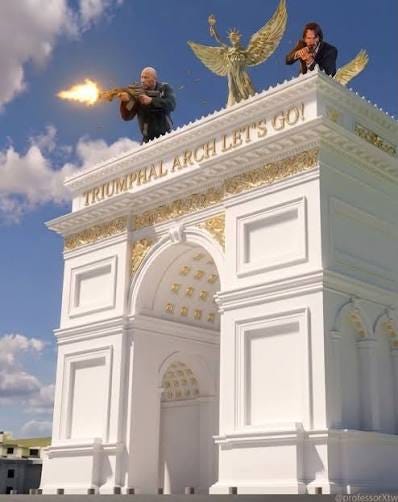
President Donald Trump announced Sunday that his proposed 250-foot arch near Arlington National Cemetery would become what he called a “Military Complex/Triumphal Arch,” capable of storing and rapidly deploying large numbers of drones while accommodating snipers on both the roof and plaza.
Trump said the change came at the “strong request” of the military.
The Pentagon has not publicly explained what military requirement suddenly emerged, and Reuters reported that a Defense Department official had nothing to add beyond Trump’s announcement. Trump himself identified no specific threat requiring a new armed installation at Memorial Circle.
That absence of explanation matters.
Because this proposed military installation would sit roughly one mile from Joint Base Myer-Henderson Hall and two miles from the Pentagon, according to Reuters. Retired Marine Col. Mark Cancian of the Center for Strategic and International Studies questioned why another military facility was necessary there and said the national-security justification appeared to have been added to strengthen the case for the arch.
And then there is Reagan National Airport.
The Federal Aviation Administration had already reviewed the 250-foot structure as an aviation obstacle. But that review did not consider launching or operating military drones from it. Rep. Don Beyer of Virginia is now calling for a new FAA safety study specifically because the mission of the building has changed.
So consider where this leaves us.
A giant ceremonial arch planned beside one of America’s most solemn military landscapes would apparently double as an ammunition-storage facility, sniper position and military drone base — near the Pentagon, near an Army installation and alongside some of the most complicated controlled airspace in the United States.
Whatever one thinks of the architecture, that is an extraordinary evolution in the purpose of the project.
And the timing is the most important part of the story.
The arch became a military facility after the project ran into trouble
Trump first promoted the arch as a grand national monument.
The administration pushed it through architectural and historic-preservation reviews. Lawsuits followed. Vietnam veterans challenged the project. Preservationists objected. A federal judge required advance notice before the administration could begin work. The National Park Service determined that the project could adversely affect historic properties.
Then came the military mission.
Five days after the National Park Service released additional planning documentation regarding adverse effects, Trump publicly announced that the monument would become a military complex.
That sequence does not prove why Trump changed the project.
But there is considerably more evidence behind the legal-strategy theory than mere speculation.
Reuters reported Tuesday that a senior White House official with knowledge of the administration’s thinking said national-security arguments are useful when Trump’s priorities encounter legal challenges because they change the legal and political terrain.
Asked about the effectiveness of the strategy, the official’s assessment was remarkably concise:
“It’s working.”
Reuters reported that the administration has increasingly invoked national security to strengthen presidential authority when projects or policies encounter lawsuits, political opposition or a lack of congressional approval.
That makes the arch much more interesting than a dispute about architecture.
Because we have seen this movie before.
Remember when the ballroom was just a ballroom?
Trump originally sold the enormous White House ballroom project primarily as a solution to an entertaining problem: presidents needed a beautiful permanent space for state dinners and major events instead of tents on the South Lawn.
Then that project ran into serious legal trouble.
And the ballroom evolved too.
The administration increasingly described the project not simply as a ballroom but as an integrated military and national-security complex.
This is not rumor. It is the government’s own argument to the United States Supreme Court.
In an August filing asking the Supreme Court to allow construction to continue, the Justice Department described the East Wing project as an integrated military complex with a highly secure ballroom above it.
And the details are extraordinary.
According to the government’s Supreme Court filing, the East Wing complex extends five stories underground and includes hardened concrete and steel, missile-resistant construction, drone-resistant ceilings and roofs, ballistic and blast-resistant glass, bomb shelters, medical facilities, classified military installations, military-grade ventilation, sniper positions and a rooftop drone port.
The government describes the facility as capable of protecting the president and maintaining command, control and communications during conventional attacks — even potentially during a nuclear attack.
So underneath and around Trump’s ballroom, the federal government is already constructing an enormous hardened presidential-security facility.
That point is important when considering the newly discovered need for another drone-and-sniper complex at Memorial Circle.
The administration may ultimately provide a military explanation distinguishing the missions of the two facilities.
So far, it has not.
The ballroom offers another important clue
The ballroom case also demonstrates why attaching national security to a construction project can matter enormously in court.
Earlier in the litigation, a federal judge blocked above-ground ballroom construction while allowing work necessary for the underground bunker and other national-security facilities to continue.
The administration then argued that separating the ballroom from the military infrastructure underneath it was effectively impossible because the entire project was integrated.
Its Supreme Court filing explicitly argued that courts traditionally defer to the military and Secret Service on presidential security and that stopping construction would create national-security risks.
On August 31, the Supreme Court allowed construction to continue while the litigation proceeds, although that ruling did not finally determine whether the project itself is lawful.
That experience is now directly relevant to the arch.
Reuters reports that a senior administration official specifically pointed to the ballroom case when discussing the usefulness of national-security arguments. The official said adding a security dimension can make courts more reluctant to intervene.
That is why the theory advanced by critics — that the arch’s sudden military mission could strengthen the administration’s position in court — cannot simply be dismissed as partisan conjecture.
It remains an interpretation of motive, not an established fact.
But the administration itself acknowledges that national-security arguments can provide legal leverage.
And that produces one very strange chronology
Consider the sequence.
Trump wants a giant triumphal arch.
The government designs a monumental public attraction.
Federal agencies spend months reviewing it.
Preservation concerns grow.
Veterans sue.
A judge restricts activity at the site.
Questions arise about congressional authorization.
A federal preservation review identifies adverse effects.
And then the monument suddenly requires drones, sniper positions and ammunition storage.
Meanwhile, less than two miles away sits the Pentagon.
About a mile away sits an active Army installation.
Across the river, the White House is already constructing a hardened military complex extending five stories underground, complete — according to the government’s own Supreme Court filing — with bomb shelters, classified military infrastructure, sniper positions and a drone port.
None of this establishes that the proposed arch has no legitimate security purpose.
But it certainly raises a straightforward question:
What military capability does this arch provide that Washington does not already possess nearby?
The administration has not publicly answered it.
There is another problem: the public project being reviewed keeps changing
This is not simply semantics.
Federal agencies reviewed a monumental arch.
Architectural commissions considered a monumental arch.
Historic-preservation officials evaluated a monumental arch.
The FAA studied whether a monumental arch would interfere with aviation.
Now the president says it is also a weapons-storage and military drone facility.
That could have consequences for security design, fencing, access, traffic, aviation, public use and the surrounding historic landscape.
If the mission has substantially changed, critics argue the government may need to revisit at least some of those reviews. The existing FAA determination, for example, did not examine military drone operations from the site.
And this is where the story becomes larger than one unusual building.
“National security” is becoming the recurring argument
Reuters examined the pattern Tuesday and found Trump increasingly invoking national security across disputes ranging far beyond conventional military questions.
Most importantly, Reuters reported that administration officials themselves recognize the legal advantages of doing so.
That doesn’t establish that every national-security argument is insincere. Presidents of both parties receive — and sometimes genuinely require — substantial judicial deference on military and security matters.
But legal experts interviewed by Reuters warned that stretching the concept too broadly can eventually undermine that deference when genuine emergencies arise.
That is the institutional question hiding behind the spectacle of a giant arch filled with drones and sniper ammunition.
A national-security designation is powerful.
Courts hesitate before second-guessing military judgments.
Historic-preservation requirements can yield to genuine security necessities.
Executive authority becomes more difficult to challenge.
And judges who might scrutinize an architectural vanity project may approach a military facility very differently.
That does not tell us what is inside Donald Trump’s head.
It does tell us why the words “military complex” can be enormously useful.
The administration should be able to answer a simple question
If the military genuinely needs this facility, explaining the basic requirement should not require revealing classified operational details.
Why this location?
Why an arch?
Why sniper ammunition there?
Why a large drone capability beside Reagan National Airport?
Why is the Pentagon insufficient?
Why is nearby Joint Base Myer-Henderson Hall insufficient?
Why is the massive new hardened White House military complex insufficient for the security mission it was designed to perform?
And when, precisely, did the military determine that a commemorative triumphal arch needed to become an armed installation?
Those answers would help distinguish a genuine newly identified military requirement from what critics and some experts believe may be something very different: a national-security rationale attached to a contested project after legal resistance emerged.
Until those answers come, the chronology remains impossible to ignore.
The arch began as a monument.
The lawsuits came.
Then came the drones.
And after watching essentially the same national-security argument help keep the White House ballroom-and-bunker complex under construction, there is now documented reason to ask whether the most important feature of Trump’s “military arch” is not what it could do on a battlefield.
It may be what calling it a military facility can do in a courtroom — an interpretation critics have advanced and one that Reuters’ reporting on the administration’s legal strategy gives substantial context, though Trump’s personal motive remains unproven.
Get him some Lego sets already.