
By Dr. John Petrone
The Pattern
With the 2026 midterm elections less than three months away, Americans are telling pollsters what they want Washington to focus on: the cost of living, the economy, and the problems affecting their families.
Donald Trump spent part of Wednesday giving reporters a tour of his construction projects.
Not metaphorically.
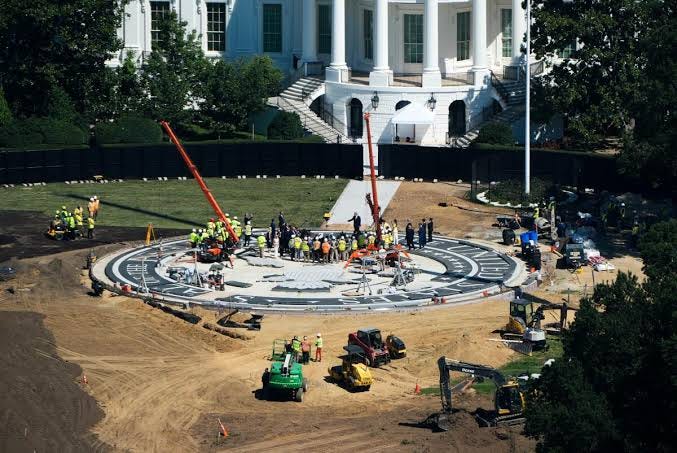
Reuters reported that Trump personally led journalists on a roughly 30-minute tour of the White House grounds, showing off a new granite helipad, a resurfaced driveway, his flagpole, landscaping, and the enormous ballroom project underway where the East Wing once stood. The Associated Press similarly described Trump slipping comfortably into the role of “builder-in-chief,” focusing on construction materials, design choices, and the permanence of his additions to the presidential complex.
At one point, while discussing a newly installed flagpole, Trump declared:
“I’m very good at flagpoles.”
That line sounds like satire.
It isn’t.
During the same tour, Trump thanked Scotts Miracle-Gro for providing grass for the White House lawn and then volunteered that the company had contributed to his campaign. The president’s own remarks were captured in a transcript of the event.
Meanwhile, The Washington Post has reported that the Trump administration is planning at least $900 million in construction projects on the White House grounds, with records indicating that much of the broader work would ultimately be taxpayer-funded.
That figure deserves to sink in.
Nine hundred million dollars.
Ballroom.
Helipad.
Granite.
Columns.
Walkways.
Landscaping.
Fountains.
Monuments.
A proposed triumphal arch.
A promenade.
A statue garden.
This is no longer a renovation project.
It is a presidency increasingly expressing itself through architecture.
And that might be merely eccentric if the country were otherwise sailing through calm waters.
It isn’t.
Why This Matters
The problem is not that presidents maintain the White House.
They should.
The White House is both a working government facility and one of America’s most important historic properties. Buildings deteriorate. Infrastructure needs modernization. Security requirements change.
The administration also has a legitimate argument that the White House has long lacked sufficient space for very large state functions. The White House says the new ballroom is intended to address that problem for future administrations, and Trump argues that some of the construction incorporates substantial security improvements.
But that reasonable argument does not explain the scale, pace, personalization, and extraordinary political attention being devoted to these projects.
And Americans appear to have other priorities.
A July Washington Post-Ipsos poll found that 54% of registered voters identified the economy and high prices as important factors in deciding their congressional vote. The same survey found 65% disapproved of Trump’s handling of the economy.
An August Reuters/Ipsos poll found that 48% of Americans considered the cost of living their most important factor in the midterms, while 70% disapproved of Trump’s handling of both inflation and the cost of living.
And a Quinnipiac University poll found that 68% of voters believed Trump was not focused enough on addressing the problems most Americans face.
Think about the collision between those two realities.
Americans are talking about groceries.
Trump is talking about granite.
Americans are worried about household expenses.
Trump is talking about flagpoles.
Americans are concerned about the economy, international conflict, health care, housing, and their ability to maintain a decent standard of living.
The president is giving reporters a guided tour of his helipad.
That does not mean a president must spend every waking hour discussing inflation.
It does mean presidential priorities communicate something.
Time is a resource.
Attention is a resource.
Political capital is a resource.
Taxpayer money is certainly a resource.
And when a president repeatedly devotes those resources to projects carrying his unmistakable personal aesthetic and legacy ambitions, the public is entitled to ask whether the presidency is being used to serve the country—or increasingly to memorialize the man occupying the office.
Constitutional Stakes
There is another issue here that is considerably more serious than whether someone prefers granite to asphalt.
Who gets to decide?
The ballroom project has already produced a major legal confrontation over presidential authority.
The D.C. Circuit Court of Appeals ruled that further above-ground construction required congressional approval, and the Trump administration has asked the Supreme Court to allow construction to proceed. The administration argues that the project incorporates important national-security infrastructure and that the president possesses authority over alterations to the White House complex. The National Trust for Historic Preservation argues that an undertaking of this magnitude cannot simply bypass congressional and historic-preservation requirements.
That dispute matters far beyond one ballroom.
The White House does not belong to Donald Trump.
It did not belong to Joe Biden.
It did not belong to Barack Obama, George W. Bush, Ronald Reagan, Franklin Roosevelt, Abraham Lincoln, or George Washington.
It belongs to the American people.
Presidents are temporary occupants of institutions designed to outlive them.
That principle is fundamental to republican government.
There is an enormous difference between maintaining a national landmark and treating it as the personal development property of whoever happens to hold executive power.
Congress possesses constitutional authority over federal spending. Courts exist to determine the lawful boundaries of executive power. Historic-preservation processes exist because nationally significant properties are supposed to survive individual political personalities.
Those checks can be cumbersome.
That is intentional.
Democracy is filled with procedures designed to prevent one person from simply saying, I want this built, therefore build it.
How We Fight Back
This should not become another tribal argument in which Americans automatically defend or condemn a construction project according to the letter beside a president’s name.
The standard should be the same regardless of who occupies the Oval Office.
Transparency.
Congress should demand a complete accounting of what every project costs, where every dollar originates, who the contractors and donors are, and which expenditures are being borne by taxpayers.
Oversight.
Major changes to nationally significant public property should go through the established legal and preservation processes—not around them.
Institutional independence.
Courts, inspectors general, congressional committees, preservation organizations, and professional civil servants must be permitted to perform their responsibilities without being treated as enemies because they ask inconvenient questions.
Public scrutiny.
Journalists should keep following the money. Citizens should keep asking whether presidential priorities correspond to national priorities. And every administration—Republican or Democratic—should know that stewardship of public property is subject to public accountability.
As a former member of the United States Air Force, I was taught something very different from personal ownership of public institutions.
You are entrusted with something temporarily.
You maintain it.
You protect it.
You improve it when necessary.
And eventually, you hand it to the person who comes after you.
That is stewardship.
The White House should be treated the same way.
The Bottom Line
Donald Trump may indeed be very good at flagpoles.
That is not the question Americans are asking their president to answer.
They want to know whether their groceries will become affordable.
Whether their wages will keep pace with expenses.
Whether their retirement will remain secure.
Whether their children will have opportunities.
Whether wars will end rather than expand.
Whether government is concentrating on the problems confronting ordinary people.
And whether hundreds of millions of dollars in public resources are being spent because the country genuinely needs something—or because one president wants to leave behind a monument bearing his unmistakable imprint.
Reuters described Trump on Wednesday emphasizing that the new granite helipad would remain long after everyone currently in Washington is gone.
Perhaps that is the most revealing part of this entire story.
Because presidents are supposed to worry about what they leave behind.
But the most important presidential legacy has never been stone.
It is whether the country was stronger.
Whether its institutions were protected.
Whether its people were better off.
Whether constitutional boundaries were respected.
Whether public money was treated as belonging to the public.
And whether the person occupying the most powerful office in the nation understood one basic truth:
The presidency is not a monument to the president.
It is a public trust.
And no amount of granite can change that.
If you believe independent, fact-based scrutiny of power still matters, subscribe to We the People United!, share this post, and keep the conversation going.


